

 English
 Español
Don't hesitate to send a message
Dog Harnesses: Types, Fit, & How to Choose the Right One
Content
Dog Harnesses: Types, Fit, and How to Choose the Right One for Your Dog
A dog harness distributes leash pressure across a dog's chest and shoulders rather than concentrating it at the neck, making it a safer and more comfortable alternative to a collar for most walking and training scenarios. The category spans a wide range of designs, materials, and intended uses — from lightweight everyday walking harnesses to padded working harnesses for service dogs, front-clip training harnesses, and heavy-duty tactical vests. Choosing correctly requires matching the harness to the specific dog, its size and body shape, and what the harness will actually be used for.
Why a Harness Instead of a Collar?
Collars are adequate for well-leash-trained dogs that do not pull and have no respiratory or tracheal vulnerabilities. For most other dogs — and particularly for breeds predisposed to tracheal collapse (Yorkshire Terriers, Chihuahuas, Pomeranians), brachycephalic breeds with compressed airways (Bulldogs, Pugs, French Bulldogs), or any dog that pulls consistently on lead — a harness is the clinically preferred option. Repeated collar pressure on the neck has been associated with elevated intraocular pressure (relevant to dogs with glaucoma risk), cervical spine stress, and tracheal damage in small breeds.
Beyond medical considerations, a harness gives the handler more mechanical control over a pulling dog's direction of travel without applying aversive force to a vulnerable anatomical area. For puppies still developing leash manners, a harness is the appropriate default from the outset.
The Main Types of Dog Harness
Back-Clip Harnesses
The leash attaches to a D-ring on the dog's back, typically between the shoulder blades. Back-clip harnesses are the most comfortable and easiest to put on, and suit calm dogs that walk without pulling. Their limitation is that a pulling dog can lean into the harness and generate significant forward force with minimal discomfort — the design provides little mechanical leverage for the handler to redirect the dog. Not recommended as the primary harness for dogs in active pull-training.
Front-Clip (No-Pull) Harnesses
The leash attaches to a ring on the dog's chest. When the dog pulls forward, the leash angle redirects the dog's front end sideways toward the handler rather than allowing forward momentum to build. This steering effect makes front-clip harnesses one of the most effective tools for managing pullers without aversive correction. They are widely recommended by veterinary behaviourists and certified trainers as a management tool during loose-leash training. One consideration: the chest clip position can cause some dogs' front legs to cross if the leash is held too taut, which is resolved by keeping the leash relaxed rather than under constant tension.
Dual-Clip Harnesses
Dual-clip harnesses include both a front chest ring and a back ring, allowing the handler to use a double-ended leash clipped to both simultaneously or to choose the clip position based on context. The dual-clip configuration with a double-ended lead gives fine-grained directional control and is a preferred setup in professional dog training and for dogs that need active leash guidance in complex environments.
Step-In Harnesses
The dog steps its front feet into two loops that are then lifted and buckled across the back. Step-in harnesses suit dogs that resist having a harness passed over their head, and are particularly popular for small breeds. The design typically provides less structural support than an over-the-head harness for larger dogs and may be less appropriate for strong pullers.
Padded and Working Harnesses
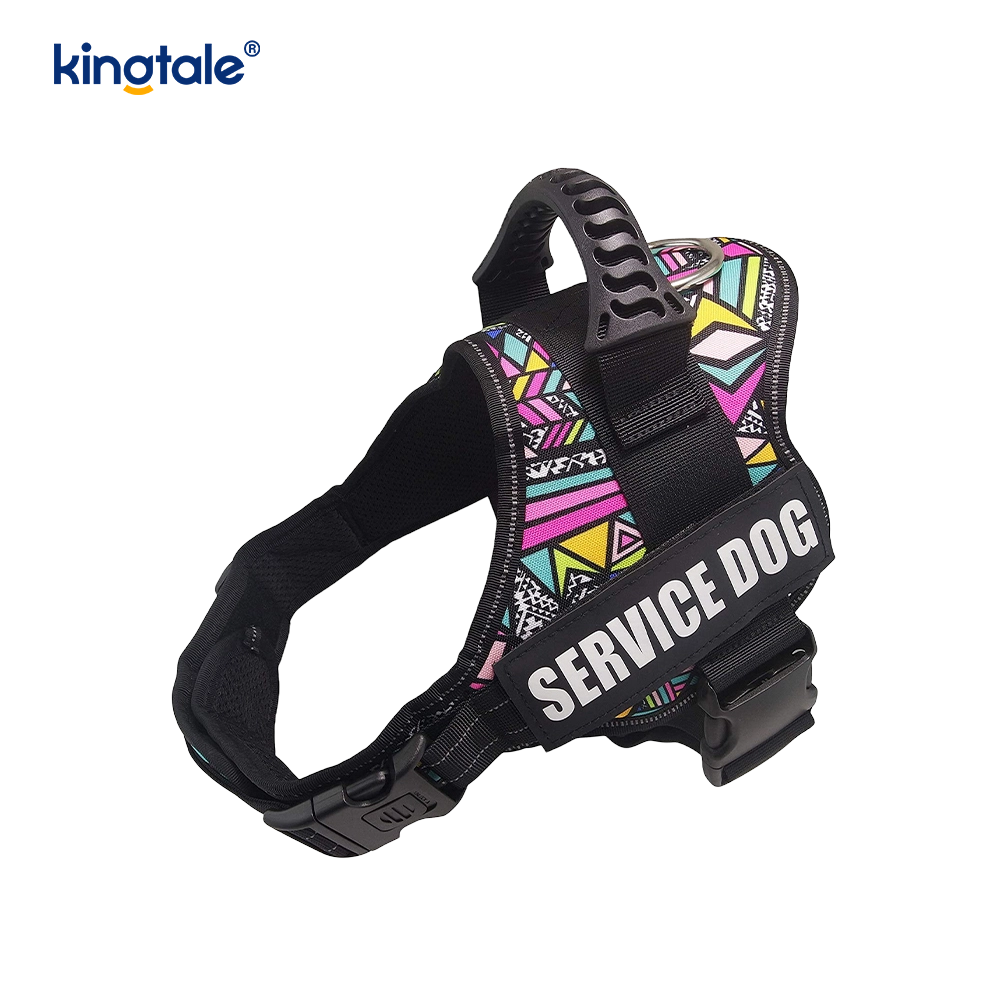
Padded harnesses distribute pressure across a wider contact area, reducing hotspots and chafing in dogs wearing a harness for extended periods — hiking, working dogs, or service animals. Working and tactical harnesses add features such as grab handles (for lifting the dog over obstacles or providing handler stability), MOLLE webbing for attaching pouches, and high-visibility panels. Service dog harnesses often include a rigid handle above the dog's back that the handler holds for mobility assistance, a fundamentally different design from a standard walking harness.
Car Safety Harnesses
Car harnesses are seatbelt-compatible restraint systems designed to keep a dog secured during vehicle travel and to distribute crash forces across the harness structure rather than a single attachment point. They are distinct from walking harnesses — a standard walking harness should never be used as a vehicle restraint, as the attachment points and webbing are not rated for crash loads. Certified car harnesses that have passed independent crash testing (such as the Center for Pet Safety testing programme in the US) carry specific load ratings and structural certifications; uncertified "car harnesses" may offer no meaningful crash protection despite their marketing claims.
How to Measure and Fit a Dog Harness
An incorrectly fitted harness is not merely uncomfortable — it can restrict shoulder movement, cause chafing and pressure sores, and in the case of an escape-prone dog, allow the animal to slip free. Correct fit is the most important factor in harness selection, ahead of brand, material, or price.
Key Measurements
- Girth (chest circumference): Measure around the widest part of the dog's ribcage, just behind the front legs. This is the primary sizing measurement for most harnesses.
- Neck circumference: Measured where a collar would sit. Required for harnesses that include a neck loop.
- Back length: From the base of the neck to the base of the tail. Relevant for step-in and vest-style harnesses to ensure the harness body covers the correct span without impeding hindquarter movement.
The Two-Finger Rule
A correctly fitted harness should allow two fingers to slide comfortably beneath any strap — snug enough that the dog cannot back out or step free, but not so tight as to restrict breathing, shoulder movement, or circulation. Check this at every adjustable point: neck loop, chest strap, and belly strap. Recheck fit periodically in growing puppies and in adult dogs whose weight fluctuates seasonally.
Shoulder Freedom Check
Many harnesses — particularly cheaper designs — position the chest strap or front panel in a way that crosses the dog's shoulder joint, restricting the natural forward extension of the front legs and potentially contributing to gait abnormalities over time. After fitting, watch the dog walk and trot: the front legs should extend forward without the harness visibly constraining the shoulder's range of motion. The chest strap should sit across the sternum (breastbone), not across the point of the shoulder.
Materials and Durability: What Dog Harnesses Are Made From
Harness webbing is most commonly nylon — lightweight, strong, available in a wide colour range, and easy to clean. Nylon webbing degrades with prolonged UV exposure and can hold moisture, which matters in wet climates or for water-working dogs. Polyester webbing offers better UV resistance and faster drying but is less common. Biothane — a PVC-coated polyester webbing — is waterproof, odour-resistant, and does not absorb water, making it the preferred material for dogs that swim regularly or work in wet conditions. It is heavier than nylon but essentially maintenance-free.
Hardware quality — buckles, D-rings, and adjustment sliders — is where budget harnesses most commonly underperform. Plastic side-release buckles on inexpensive harnesses may crack in cold temperatures or fail under sudden load. For larger, stronger dogs, look for harnesses using metal hardware (aluminium or steel) at load-bearing points, particularly the leash attachment D-ring. The D-ring should be stitched with reinforced bar-tack stitching or riveted, not simply threaded through a webbing loop.
| Harness Type | Best For | Pull Control | Ease of Use |
|---|---|---|---|
| Back-clip | Calm walkers, small breeds | Low | Very easy |
| Front-clip (no-pull) | Pullers, leash training | High | Moderate |
| Dual-clip | Training, reactive dogs | Very high | Moderate |
| Step-in | Head-shy dogs, small breeds | Low–moderate | Easy |
| Padded / working | Hiking, service dogs, long wear | Moderate (back clip) | Moderate |
| Car safety | Vehicle travel restraint | N/A | Easy |
Special Considerations by Breed and Body Type
Standard harness sizing assumes a broadly proportionate dog. Several body types require specific consideration:
- Deep-chested breeds (Greyhounds, Whippets, Salukis, Dobermanns): The girth-to-neck ratio is unusually large. Standard harnesses sized on girth will be too loose at the neck; those sized on neck will be too tight at the chest. Look for harnesses designed specifically for sighthound body types, or adjustable designs with independent neck and girth adjustment.
- Brachycephalic breeds (Bulldogs, Pugs, French Bulldogs, Boxers): The compressed facial anatomy and associated respiratory compromise make harnesses mandatory over collars. A wide, padded chest panel distributes pressure gently and avoids the neck entirely.
- Small and toy breeds: Hardware weight is a meaningful consideration — a heavy metal buckle on a 3 kg dog represents a disproportionate load. Lightweight plastic hardware and thin webbing suit small breeds. Step-in and vest-style designs are generally more comfortable for very small dogs than traditional strap harnesses.
- Escape artists: Some dogs — particularly anxious or hand-shy individuals — have learned to reverse out of harnesses. For these dogs, choose a harness with a neck loop that closes the escape route from the front, combined with a belly strap. A martingale-style closure on the neck loop, which tightens slightly under backward pressure, can prevent backing out without applying aversive constant pressure.
- Dogs with orthopedic conditions: Dogs recovering from surgery or managing hip dysplasia, elbow dysplasia, or intervertebral disc disease (IVDD) may benefit from a support harness that includes a handle above the hindquarters, allowing the handler to provide lift and stability assistance on stairs and uneven terrain.



Reliable Materials - Sourced for performance and pet safety.
Quick Links
Ready to Customize Your Pet Products?
