

 English
 Español
Don't hesitate to send a message
Breakaway Cat Collars: Buckle Force, Correct Fit, and What Vets Recommend
Content
- 1 What Is a Breakaway Cat Collar and How Does the Safety Buckle Work
- 2 Breakaway vs. Quick-Release vs. Elastic vs. Standard Buckle
- 3 How to Fit a Breakaway Cat Collar So the Safety Feature Actually Works
- 4 When a Breakaway Collar Is the Wrong Choice
- 5 What Wholesale Buyers and Brands Should Verify Before Sourcing Breakaway Cat Collars
- 6 Breakaway Cat Collar FAQ
At 9.2 pounds, a cat named Miso weighed about the same as the average adult house cat. When she jumped from a window ledge, her collar snagged on a drawer pull, and the buckle held long enough to compress her airway. That exact moment is what the breakaway cat collar was designed to eliminate: a buckle that separates under pressure so the cat slips free instead of hanging. In pet owner communities, the rule is blunt - if a cat wears a collar, it should be a breakaway.
What Is a Breakaway Cat Collar and How Does the Safety Buckle Work
A breakaway cat collar is a collar equipped with a safety buckle that separates into two pieces when pulling force exceeds a set threshold, allowing the cat to free itself from a snag without human help. The release happens at the buckle, not at the stitching or the D-ring.
Definition A collar whose buckle releases automatically under tension, calibrated to open above normal movement forces and below the cat's full bodyweight pull.
Inside the buckle, two interlocking halves are held by a spring-loaded latch. When the strap is pulled from both sides with enough tension, the latch releases and the halves separate. Most breakaway buckles for cat collars are calibrated to release between 5 and 9 pounds of force, a window that sits above normal movement and below a cat's full bodyweight pull.
A typical adult cat weighs 8 to 11 pounds, so the 5-9 lb release threshold opens well before dangerous neck compression. A fixed-buckle collar has no such limit, and a panicked cat can generate pulls of 15 lb or more - enough to threaten the trachea or jugular.
 Reflective Breakaway Cat Collar with Bell and Adjustable FitThis reflective collar's breakaway buckle releases under pressure, helping protect cats from snagging hazards. It adjusts from 7.5 to 12.5 inches, includes a removable bell, and comes in a two-pack with multiple colors.View Product →
Pull force comparison for a typical adult cat
Normal walking / head movement 1-2.5 lb
Scratching and grooming tugs 2-4 lb
Collar snag on a branch or edge 4-6 lb
Breakaway release threshold 5-9 lb
Cat jumping / full bodyweight pull 8-12 lb
Sustained airway risk pressure 10+ lb
The most important specification on a cat collar is the release threshold of its buckle, not the pattern, the color, or the webbing width.
Breakaway vs. Quick-Release vs. Elastic vs. Standard Buckle
The breakaway buckle is the only cat collar closure that opens automatically under tension. A quick-release buckle needs a finger to press a button, an elastic collar merely stretches, and a standard buckle holds until someone unclips it manually.
Quick-release collars work well in grooming or veterinary settings where a handler removes the collar in one motion. For daily wear, they depend on a person being present at the exact second the collar snags, and an unattended cat cannot press its own button.
Elastic collars reduce the rigidity of a snag but do not open. The elastic can also let the collar slip over the head and then sit around the neck as a loop that does not release.
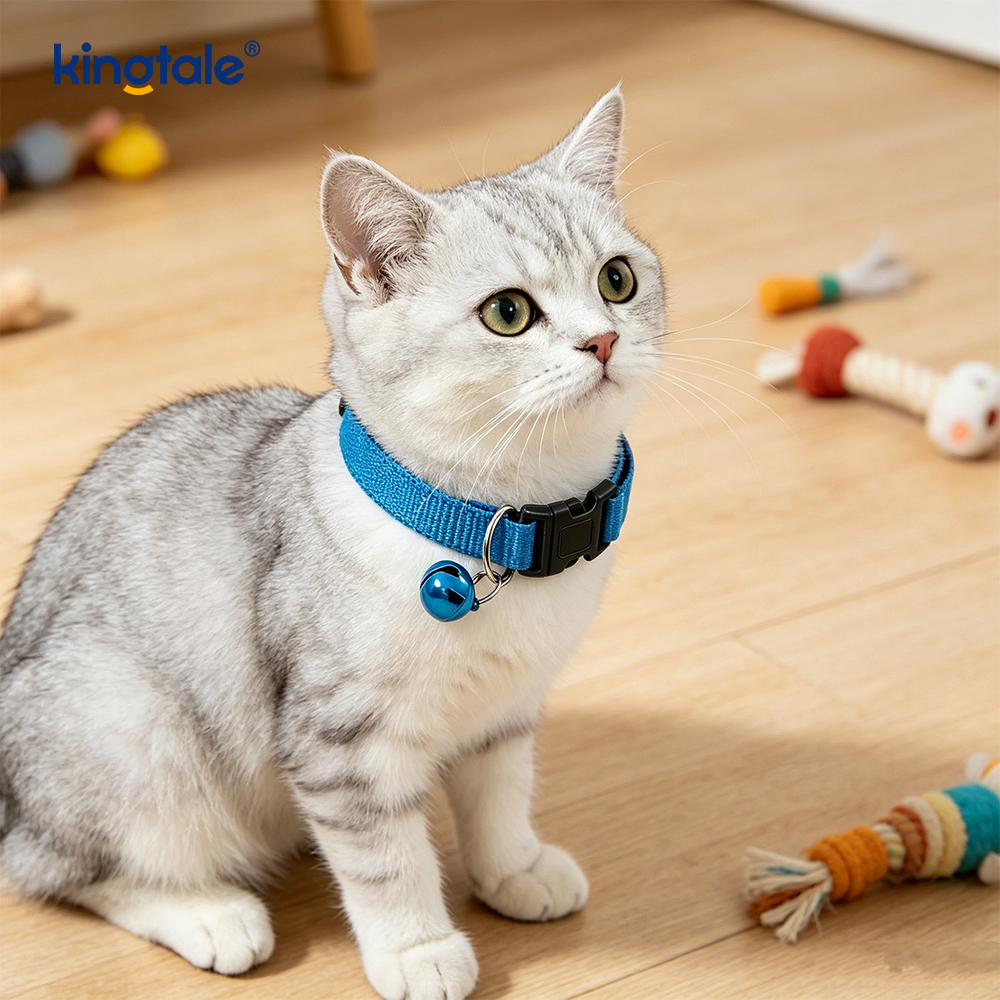 Quick-Release Safety Cat Collar with Bell and Durable NylonFeaturing a buckle that pops open under tension to prevent strangulation, this adjustable collar fits cats and small dogs. It includes a removable bell, metal D-ring, and skin-friendly webbing for comfortable daily wear.View Product →
| Collar type | How it opens | Release force | Primary consideration |
| Breakaway | Automatic under tension | 5-9 lb | Safest default for most cats |
| Quick-release | Manual button or latch | Not applicable | Needs a human hand at the right moment |
| Elastic / stretch | Does not open, only stretches | Not applicable | Can tighten as a loop around the neck |
| Standard buckle | Manual unclip | Not applicable | No automatic release and the highest snag risk |
Veterinary guidance and safety reviews converge on one rule: if a cat wears a collar, the breakaway mechanism is the baseline, and any other closure type is a trade-off that the owner must consciously justify.
How to Fit a Breakaway Cat Collar So the Safety Feature Actually Works
A breakaway collar that is too tight, too loose, or fitted with the buckle in the wrong spot will not release as designed. Fitting a breakaway collar is a safety procedure, not a comfort adjustment.
- Measure the cat's neck with a soft tape where the collar will sit. Leave about one finger of slack under the tape so the collar can move without spinning.
- Position the buckle at the side of the neck, not under the chin and not on top. A side position lets both halves pull apart cleanly when tension comes from any direction.
- Two fingers should slide under the collar, but it should still rotate without turning upside down. If it leaves fur indentations after two hours, it is too tight.
- Test the release before letting the cat walk away. Hook the collar on a doorknob, pull at a 45-degree angle, confirm the buckle splits, then click it back together.
- Re-test monthly. Hair, dust, and dried saliva can stiffen the latch and push the release force upward over time.
Correctly fitted, a breakaway collar releases when the cat's full bodyweight is applied, but not when the cat shakes its head, scratches an ear, or plays with a toy. The measurement logic follows the standard used on the production line at Zhangjiagang Kingtale International Co., Ltd. (Kingtale), whose guide to adjustable pet collar sizing covers this check in more detail.
Fit check A breakaway collar passes its fit check when two fingers slide under the strap, the buckle sits at the side of the neck, and a doorknob test produces a clean release.
When a Breakaway Collar Is the Wrong Choice
Breakaway collars are the safest default for the large majority of cats, but they are the wrong tool in three situations: leash walking, high-escape-risk environments, and cats wearing heavy tracking attachments.
On a leash, a breakaway buckle pops open the moment a startled cat bolts to the end of the lead. The collar separates, the leash drops, and the cat is gone. Leash training belongs on a harness, never on a breakaway collar alone.
Some cats learn to hook the collar on furniture to pop the buckle on purpose. Repeated escapes should be handled by changing the environment or using a harness for supervised outdoor time, not by switching to a fixed buckle that trades escape risk for strangulation risk.
A GPS tracker or heavy ID tag can add enough weight that normal head-shaking produces forces close to the release threshold, dropping the collar in the yard and defeating the tracking feature.
Breakaway works well
- Indoor cats wearing ID tags
- Supervised outdoor time
- Kittens growing through sizes
- Multi-cat households with play fighting
Choose another setup
- Leash walks and harness training
- Cats that deliberately pop the buckle
- Heavy GPS or tracker mounts
- Owners who need positive retention control
What Wholesale Buyers and Brands Should Verify Before Sourcing Breakaway Cat Collars
For importers, private-label brands, and retailers, the breakaway buckle is the product and the webbing is the strap. Supplier quality control on the buckle determines whether the inventory is safe to sell under your own brand.
- Release force consistency. A batch should release within the agreed threshold, usually 5-9 lb, both when new and after repeated cycles. Ask for release-force test data on the buckle model before approving the order.
- Buckle cycle life. A buckle that cracks or fails to re-latch after 50 releases turns into returns and liability. A quality nylon buckle should survive several hundred open-close cycles.
- Webbing and stitching. Cat collar webbing should be flat, low-abrasion nylon or polyester with bar-tack stitching at every stress point.
- D-ring and hardware. The ring that holds ID tags should be welded or riveted, not glued, and the hardware must be rust-resistant.
- Customization capability. Color matching, logo printing, custom buckle colors, and tag options are standard OEM requests.
Zhangjiagang Kingtale International Co., Ltd. (Kingtale) has manufactured and exported pet accessories for over 16 years. Its catalog includes adjustable reflective breakaway cat collars, quick-release safety collars with bells, and flashing safety collars, all available for wholesale and OEM/ODM production.
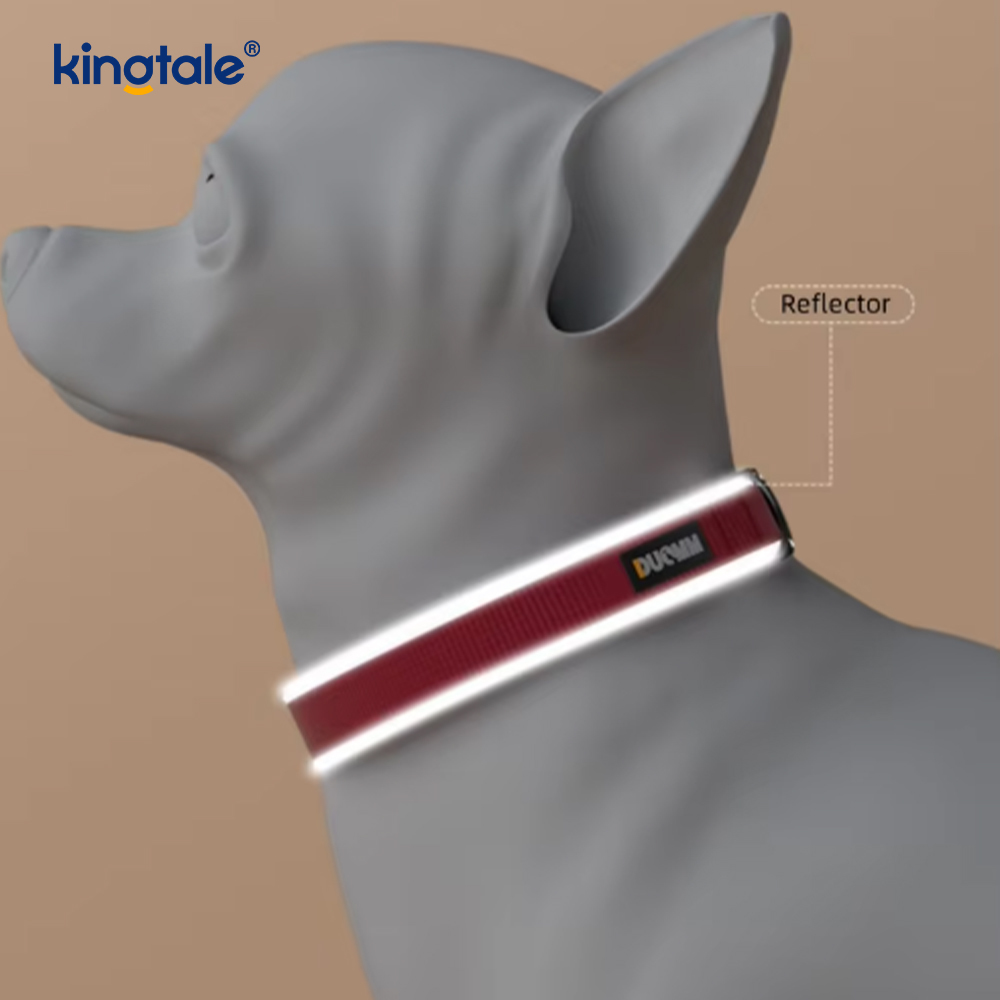 Adjustable Flashing Safety Collar for Dogs and CatsThis whistles-free collar offers dual D-rings for secure leash attachment, reflective strips for nighttime visibility, and a secure locking buckle. Made with durable nylon, it suits small to large dogs and is available for wholesale.View Product →
Sourcing rule: write the release-force specification into the purchase order. Do not assume it from a sample.
Buyers can contact Kingtale's export team to request test data, material samples, and lead times before committing to a production run.
Breakaway Cat Collar FAQ
Do veterinarians recommend breakaway cat collars?
Yes. Veterinarians generally recommend breakaway collars as the safest option for cats that must wear collars, because the automatic release prevents strangulation accidents in the home. The common exception is leash walking, where a harness is the safer tool.
How much force does a breakaway collar need to open?
Most breakaway cat collars open under 5 to 9 pounds of pulling force. The range is set below the bodyweight of a typical adult cat, so a snagged cat can break free, while normal movement, grooming, and play do not trigger the release.
Can cats remove their own breakaway collars?
Yes. Because breakaway collars are designed to open under tension, a determined cat can sometimes pop the buckle by hooking it on furniture or shaking hard. If a cat keeps escaping its collar, use a harness for supervised outdoor time instead of switching to a fixed buckle.
Are breakaway collars safe for kittens?
Yes, when the collar is sized for the kitten and the release force matches its weight. Many breakaway buckles are made in kitten-weight versions that release at the lower end of the 5-9 lb range, and the fit should be rechecked every two weeks as the kitten grows.
Bottom line: a breakaway collar does not guarantee against every accident, but it removes the most common and most preventable injury pattern in cats that wear collars.



Reliable Materials - Sourced for performance and pet safety.

Quick Links
Ready to Customize Your Pet Products?
