

 English
 Español
Don't hesitate to send a message
How to Choose an Adjustable Dog Recovery Collar That Actually Fits Your Dog
Content
- 1 What Makes an Adjustable Dog Recovery Collar Different
- 2 Sizing Starts with Two Measurements, Not a Breed Chart
- 3 Material Choice Decides Whether the Collar Lasts the Full Healing Period
- 4 The Durability Difference in Numbers
- 5 What to Look For When Buying or Sourcing Recovery Collars
- 6 FAQ: Adjustable Dog Recovery Collars
When a dog leaves the clinic after surgery, the recovery collar is the only barrier between the wound and the dog's tongue. Veterinary teaching hospital data suggests that self-trauma - licking, chewing, or rubbing - accounts for roughly one in five surgical-site complications in dogs, and in most of those cases the collar was fitted by breed label instead of actual neck measurement. An adjustable dog recovery collar closes that gap: it lets the owner adjust both the neck opening and the protective depth, so one product can fit a 7 kg puppy and a 15 kg adult without cutting circulation or leaving a gap at the throat. This guide translates 16 years of production experience at Zhangjiagang Kingtale International Co., Ltd. into the measurements, material choices, and construction details that decide whether a collar works for the full 10-to-21-day healing period.
1 in 5 post-operative complications in dogs trace back to self-trauma that a correctly sized recovery collar could have prevented.
What Makes an Adjustable Dog Recovery Collar Different
An adjustable dog recovery collar is a post-surgical protective device whose neck opening, protective depth, or both can be resized through a mechanical closure system, giving it a continuous fit range instead of one fixed circumference. That continuous range is the difference between it and a classic cone: a plastic e-collar is molded to one neck size, while an adjustable collar uses straps, buckles, and layered seams to span several sizes in a single unit.
Three structural points must be adjustable for the collar to protect a healing wound in practice:
- Neck opening, controlled by the strap, buckle, or hook-and-loop closure that wraps the neck without pinching or slipping
- Protective depth, the distance from the neck opening to the outer rim that blocks the dog's jaw from reaching the wound
- Rim stiffness, set by seams or an internal stay, which keeps the collar from folding flat when the dog pushes against furniture
Fit range beats label size. A collar that spans 25-38 cm of neck circumference is only useful if its closure holds evenly across that range. Graduated buckles and two-row hook-and-loop closures keep the strap from pivoting off-center during sleep, scratching, or doorway rubbing.
Sizing Starts with Two Measurements, Not a Breed Chart
Measure neck circumference with two fingers under the tape, then measure neck length from the base of the skull to the top of the shoulder blades; the collar must cover both dimensions or the dog will still reach the wound.
Breed charts fail because two dogs of the same breed can differ by 4-5 cm in neck circumference and 3-4 cm in neck length. In our factory, we see this on every production batch: whippet mixes, in particular, vary wildly even inside one litter. The measurement routine takes less than two minutes and removes the guesswork:
- Wrap a soft tape around the neck where a regular collar sits, and slide two fingers under the tape to account for bandaging and postoperative swelling.
- Measure from the base of the skull to the top of the shoulder blades; this is the minimum inner depth the collar must provide.
- Add 2 cm to the circumference reading, then confirm the collar's adjustment range covers that number with room to spare.
- Fit the collar, check that it spins freely without choking, and confirm the dog cannot touch the wound when stretching, lying down, or scratching an ear.
Correct fit
Two fingers slide between strap and neck, the outer rim extends past the muzzle reach, and the closure sits in the middle third of its adjustment range.
Wrong fit
The strap is forced to its last hole, the rim stops short of the jaw line, or the collar shifts forward and exposes the throat on one side.
| Size class | Neck circumference | Typical breeds | Recommended depth |
| Small | 18-27 cm | Kittens, toy breeds, puppies | 6-8 cm |
| Medium | 25-38 cm | Beagles, corgis, small terriers | 8-12 cm |
| Large | 35-50 cm | Labs, shepherds, retrievers | 12-16 cm |
| Extra large | 48-65 cm | Mastiffs, Great Danes, giant breeds | 16-20 cm |
Never buy by breed weight alone. If the adjustment strap sits at its last hole when fitted, the collar is already wrong even though the label says it fits.
Material Choice Decides Whether the Collar Lasts the Full Healing Period
Coated nylon outlasts every other common recovery-collar material in continuous wear, holding its structure for roughly 28 days under repeated scratching and rubbing.
Healing periods run from 7 days for minor lacerations to 14-21 days after orthopedic or abdominal surgery. That is 500 or more hours of constant wear, meals, sleep, and the occasional attempt to rub the collar off against a door frame. Material behavior under those conditions is predictable:
| Material | Weight | Water resistance | Cleaning | Durability | Best use |
| Clear PVC | Light | Excellent | Wipe clean | Moderate | Short-term aftercare |
| Coated nylon | Medium | Excellent | Hose or wipe | High | 2-3 week healing |
| Leather | Heavy | Poor at seams | Conditioner | High with care | Premium visible wear |
| Fleece-lined polyester | Medium | Fair | Spot clean | Moderate | Comfort-focused recovery |
Material performance also matters in everyday walking and training contexts, where the same nylon-leather-neoprene trade-offs apply to standard collars and harnesses.
PVC is lighter but scratches into bacterial reservoirs. Uncoated fabric absorbs wound fluid and traps odors. Leather demands daily conditioning in humid climates. Choose the material that matches the length of recovery, not the look.
The Durability Difference in Numbers
Structural durability, measured in days until a collar loses its shape, develops cracks, or begins absorbing fluid, favors coated nylon by a wide margin in continuous-wear conditions.
Structural life in continuous wear: days until the collar loses shape or shows fluid absorption in production testing.
The practical consequence is simple: a 14-day recovery can be completed on a PVC collar, but a 21-day orthopedic recovery almost always needs coated nylon or a carefully maintained leather collar.
Bottom line: for most dogs, a coated-nylon adjustable recovery collar is the only option that outlives the healing timeline without structural failure.
What to Look For When Buying or Sourcing Recovery Collars
Four construction details predict whether a recovery collar survives the full healing period: stitching density, buckle grade, padding thickness, and the internal stiffener.
8-10
stitches per inch on strap and body seam
POM
or zinc-alloy buckle rated for thousands of adjustment cycles
2-3 cm
closed-cell foam padding around the neck line
PET
semi-rigid stay keeps the rim from folding under chewing
Retail buyers and wholesale importers see these details in return rates. A collar with thin stitching fails at the buckle within a week, and a collar without a stiffener folds flat the first time the dog pushes against a wall. Every recovery collar we export at Kingtale is inspected against these four points before packing.
For everyday post-surgical aftercare, a soft collar with a washable sustainable shell covers the standard 7-to-14-day recovery window without the clatter of a plastic cone.
For wholesale programs and private-label lines, a custom soft recovery collar with branded adjusters gives distributors a differentiated product without a long development cycle.
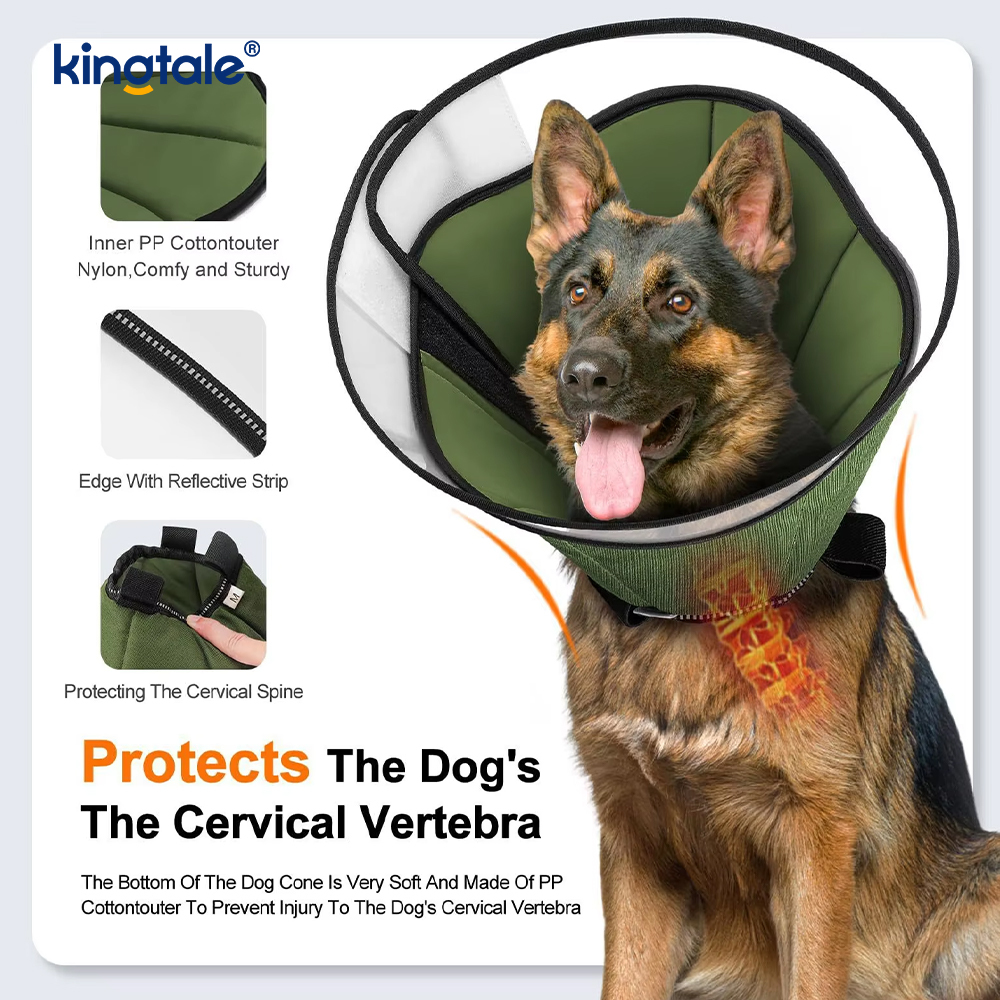 Soft Fabric-Lined Dog Cone with Transparent PVC EdgeThis recovery collar offers a softer alternative to rigid plastic cones, with a visible transparent edge for medium to large dogs. It suits owners seeking comfort and cleanliness while preventing licking after surgery.View Product →
For clinics and owners who prefer the coverage profile of a classic cone without its brittleness, a coated-nylon cone alternative remains the durable, cleanable choice.
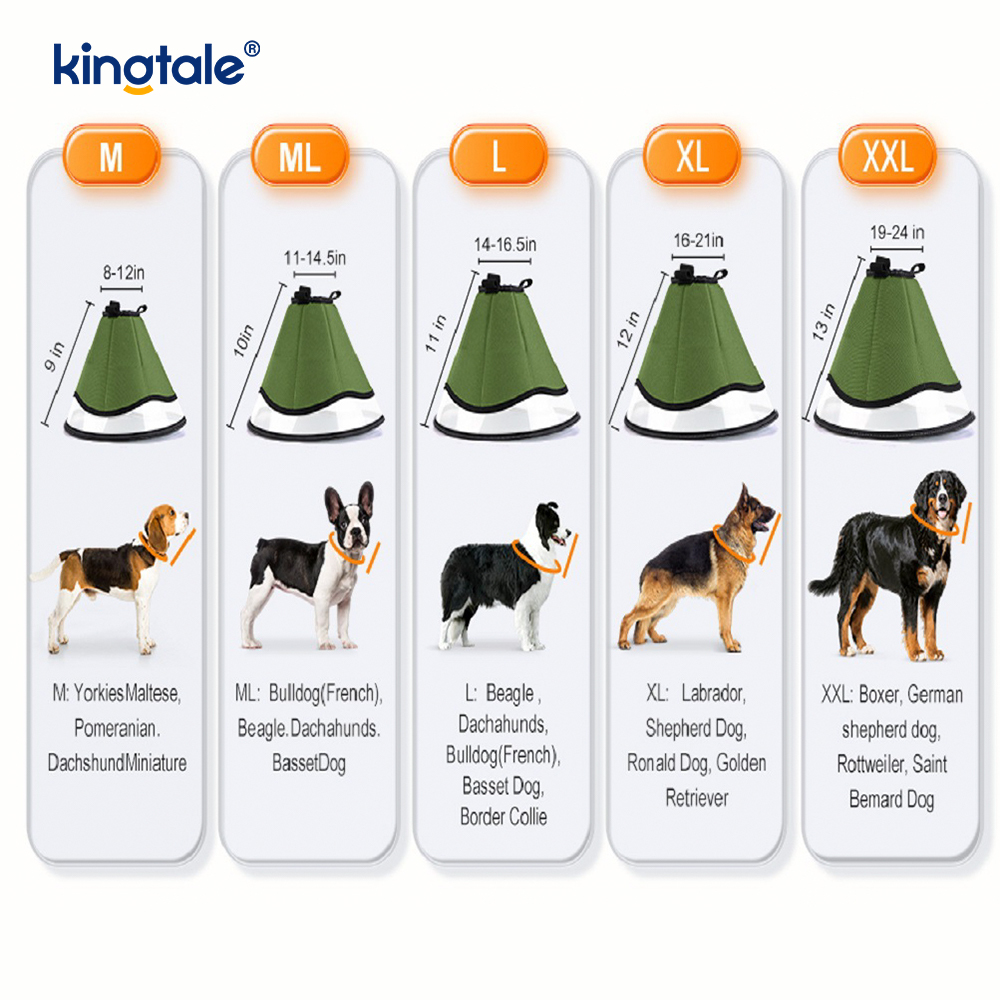 Durable Nylon Dog Recovery Collar with Adjustable ClosureA coated-nylon cone alternative that is washable and long-lasting, featuring a padded oxford fabric lining and adjustable fastener. Ideal for clinics or owners wanting classic coverage without brittleness.View Product →
Buyers evaluating wholesale quantities, custom colors, or OEM branding can contact our export team with the sizing table from this guide, and we will match the product spec to your target market.
FAQ: Adjustable Dog Recovery Collars
How long should a dog wear an adjustable recovery collar?
For the entire healing period plus a short overlap, usually 10 to 21 days. The collar stays on until the veterinarian confirms the wound is sealed and the dog no longer tries to lick or scratch the site. Removing it early is the most common cause of repeat visits.
Can a dog eat and drink while wearing a recovery collar?
Yes, if the collar is sized correctly. The inner depth must clear the food bowl enough for the lower jaw to reach the bowl while the outer rim still blocks the tongue from the wound. Wide, shallow bowls make this easier than tall narrow bowls.
How do I clean a soft recovery collar?
Wipe coated nylon with soap and water daily, and remove the washable cover if the design includes one. PVC cones can be wiped with any pet-safe disinfectant. Leather collars require dry cleaning and conditioning; fluid at the stitching lines is the first sign of failure.
Is a recovery collar better than a surgery suit?
For wounds on the torso, a recovery suit often works better. For wounds on the head, ears, paws, or tail, an adjustable recovery collar is the stronger choice because the suit cannot block access to those areas. Many clinics use a collar during the day and a suit at night to spread pressure points.



Reliable Materials - Sourced for performance and pet safety.
Quick Links
Ready to Customize Your Pet Products?
