

 English
 Español

Don't hesitate to send a message
Cat Litter Mat Buying Guide: Stop Litter Tracking, Odor, and Floor Damage
Content
- 1 Why Litter Tracking Is a Cost Problem, Not Just a Cleaning Problem
- 2 The Five Non-Negotiables for a Cat Litter Mat That Actually Works
- 3 Cat Litter Mat Materials Compared: TPR vs. EVA vs. Silicone vs. Fabric
- 4 Right Size, Right Place: Positioning Rules That Cut Tracking by 70-80%
- 5 Cleaning and Lifespan: Why "Washable" Is Not Always Better
- 6 Three Mistakes That Make Any Cat Litter Mat Fail
- 7 Frequently Asked Questions About Cat Litter Mats
Your cat leaves the litter box four to six times a day. Each exit carries five to fifteen granules of clay or crystal litter lodged between its paw pads. That adds up to 30-90 granules on your floor every day, or roughly 11,000-33,000 granules per year. Those granules do more than look untidy: they abrade hardwood finishes, hitch rides into beds and upholstery, and track microscopic waste residue across the house. A properly selected cat litter mat interrupts that chain at the source. This guide explains how to evaluate mats the way a pet product manufacturer would - with attention to material, texture, edge design, and cleaning behavior - so you can buy one that actually performs.
Why Litter Tracking Is a Cost Problem, Not Just a Cleaning Problem
Litter tracking is a measurable cost source that most households underestimate. Once you calculate the losses, the case for a serious mat becomes financial rather than aesthetic.
- Litter waste: With a 10 kg bag of clumping clay litter priced at $8-12, the 5-10% of granules typically tracked out represents $6-15 of pure loss per year.
- Floor damage: Clay and silica granules contain quartz particles with a Mohs hardness of 7, which exceeds most hardwood finishes. Daily foot traffic grinds those particles into the coating like fine sandpaper.
- Hygiene spread: Granules carry microbes from the box, including Escherichia coli and Toxoplasma gondii oocysts, directly into kitchens and bedrooms.
- Cleaning time: The average multi-surface home needs 20-30 extra minutes per week to sweep, vacuum, and wipe tracked litter.
30-90granules tracked per day
$6-15litter wasted per year
20-30extra cleaning minutes per week
A single cat can deposit more than 300,000 litter granules on your floors over a ten-year lifespan.
The Five Non-Negotiables for a Cat Litter Mat That Actually Works
A good cat litter mat does exactly one job: it strips granules from paw pads before they reach the floor. It fails when any of five design elements is missing.
- Aggressive surface texture. Honeycomb, raised nub, or brush-like patterns reach into the grooves of the paw pad. Flat EVA or smooth silicone surfaces let granules slide straight off the edge.
- Raised edge or containment border. At least one elevated edge traps granules when the cat lands on the mat. A flat mat collects granules, then dumps them sideways on the next step.
- Non-slip backing. The impact of a cat jumping out of the box pushes a mat without grip across the floor. A sliding mat also feels unstable to the cat, which will start walking around it.
- Enough length. The mat must cover the cat's landing and slide zone, normally 50-70 cm beyond the box opening - not just a small square in front of the box.
- Easy cleaning. The mat must shake clean, rinse fast, and dry within a few hours. Absorbent materials that stay damp for 24-48 hours become a bacterial breeding ground.
Litter trackingLitter tracking is the transfer of litter granules, dust, and microbial residue from a cat's paws to the surrounding floor surface. An effective mat reduces this transfer by physically removing granules from the paw pad before the cat steps off the pad.
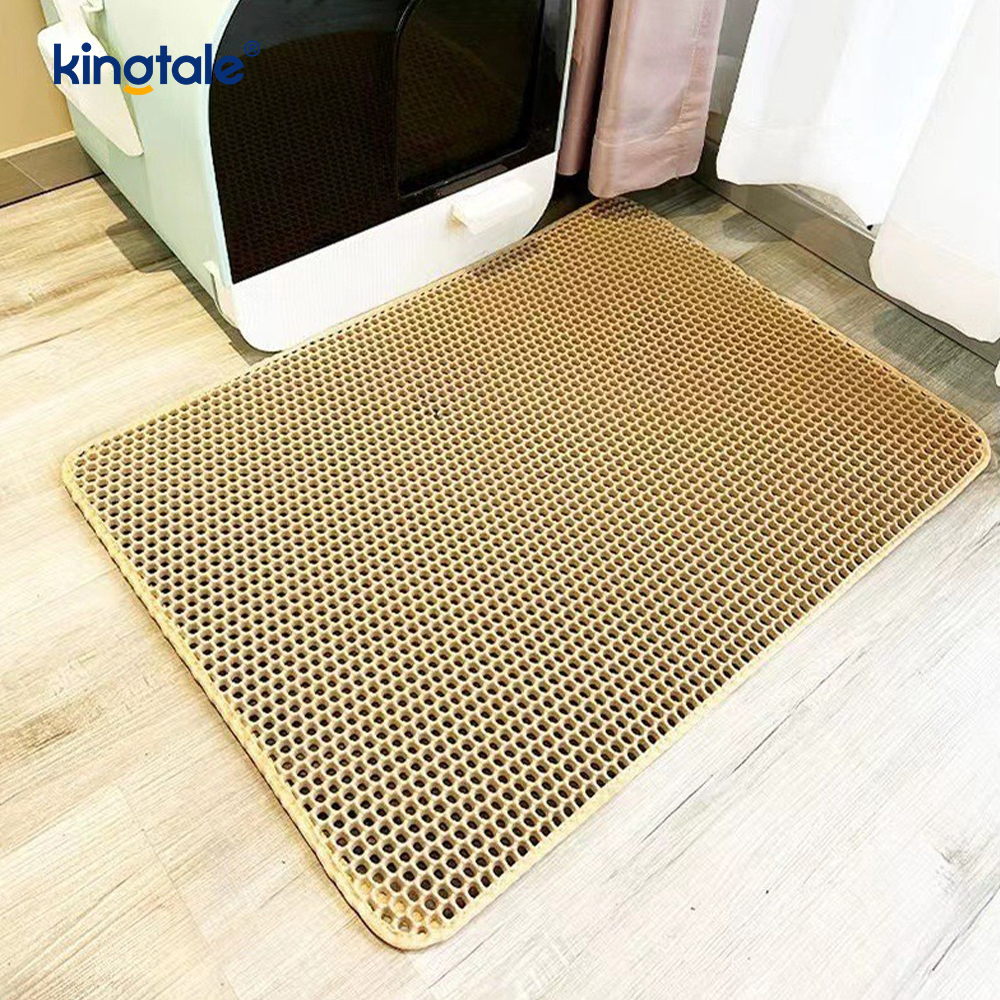 EVA Cat Litter Mat with Grip and Foldable DesignMade from durable EVA, this washable mat offers wear resistance and a firm grip to prevent sliding, making it a practical choice for trapping litter and keeping floors clean.View Product →
Cat Litter Mat Materials Compared: TPR vs. EVA vs. Silicone vs. Fabric
Material determines both trapping efficiency and whether your cat will accept the mat at all. TPR and EVA deliver the best balance in most households.
| Material | Granule retention | Cleaning effort | Cat acceptance | Typical lifespan |
| TPR | High - porous structure grips deeply | Easy - rinse and air dry | Medium to high | 12-18 months |
| EVA | Medium-high - honeycomb texture | Moderate - absorbs moisture | High - soft under paws | 6-12 months |
| Silicone | Medium - depends on pattern depth | Very easy - non-porous | Medium - some cats avoid it | 18-24 months |
| Fabric | Medium-high - physical trap | Hard - hard to deep clean | High - but retains odors | 3-6 months |
Litter Tracking Prevention Index by Material (0-10)
TPR
9.2
EVA
8.5
Fabric
7.4
Silicone
6.8
Index combines granule retention, cleaning ease, and durability scores.
Zhangjiagang Kingtale International Co., Ltd., a vertically integrated manufacturer and exporter with more than 16 years of production experience, evaluates these materials for paw-pad contact, wash durability, and anti-slip performance before they reach its wholesale catalog.
A mat that your cat refuses to walk on provides zero retention. When a material change triggers avoidance behavior, switch texture before switching brands.
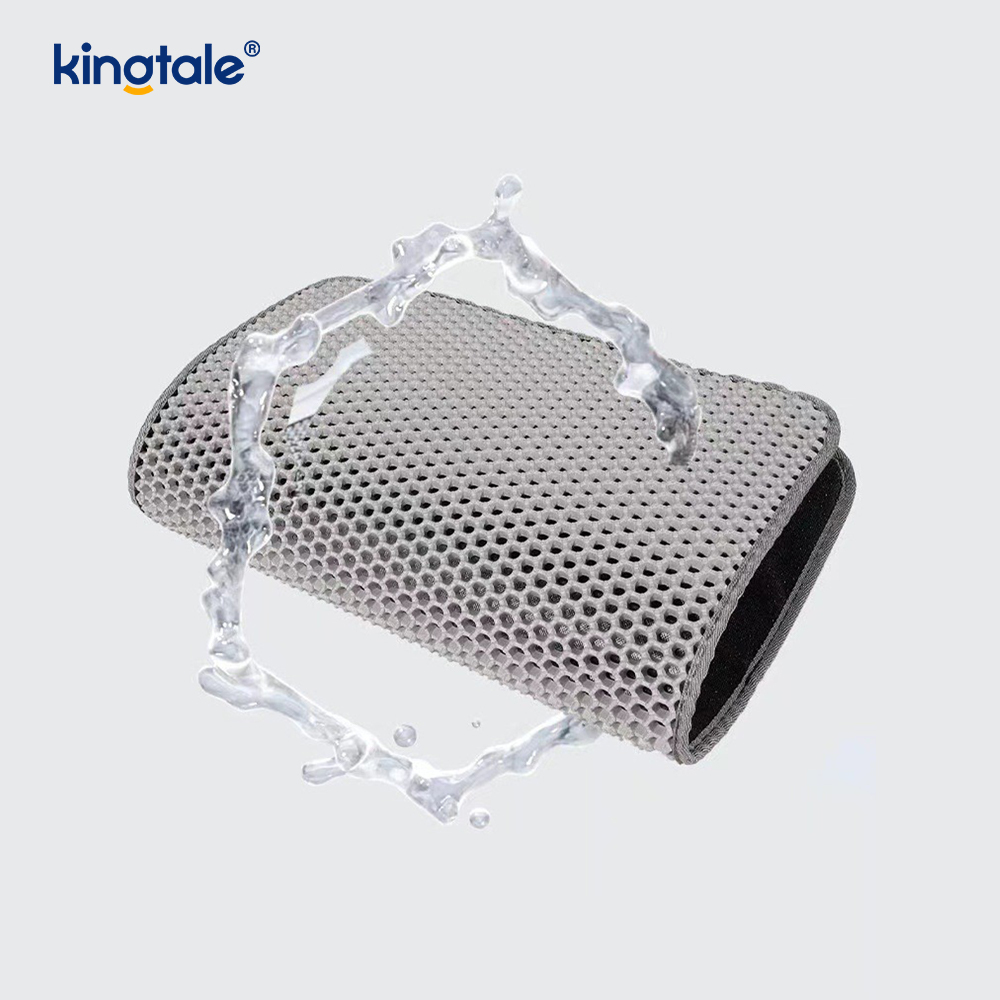 Upgraded Waterproof Cat Litter Mat with Double-Layer TrappingFeaturing a sealed, leak-proof bottom and a mesh top, this mat captures litter effectively and protects floors from liquid. Available in multiple sizes for optimal placement.View Product →
Right Size, Right Place: Positioning Rules That Cut Tracking by 70-80%
A correctly sized and positioned cat litter mat removes 70-80% of tracked granules before they reach the floor, regardless of material. Size and placement matter more than brand or price.
- Cover the landing zone. Measure from the box opening to where the cat lands after jumping out. For most cats that distance is 60-80 cm, so a mat of at least 60 x 40 cm is the practical starting point.
- Multi-cat households need more surface. Two mats placed side by side, or in an L-shape, cover cats that exit in different directions.
- Align the mat with the actual exit. If the cat jumps over the front rim and lands to the left, the mat must sit where the paws land, not directly in front of the box.
- Leave no gap. Place the mat flush against the box edge. A gap of even 2-3 cm lets granules fall onto the bare floor.
Rule of thumb: if the mat does not extend beyond your cat's landing zone, it is a doormat, not a litter mat.
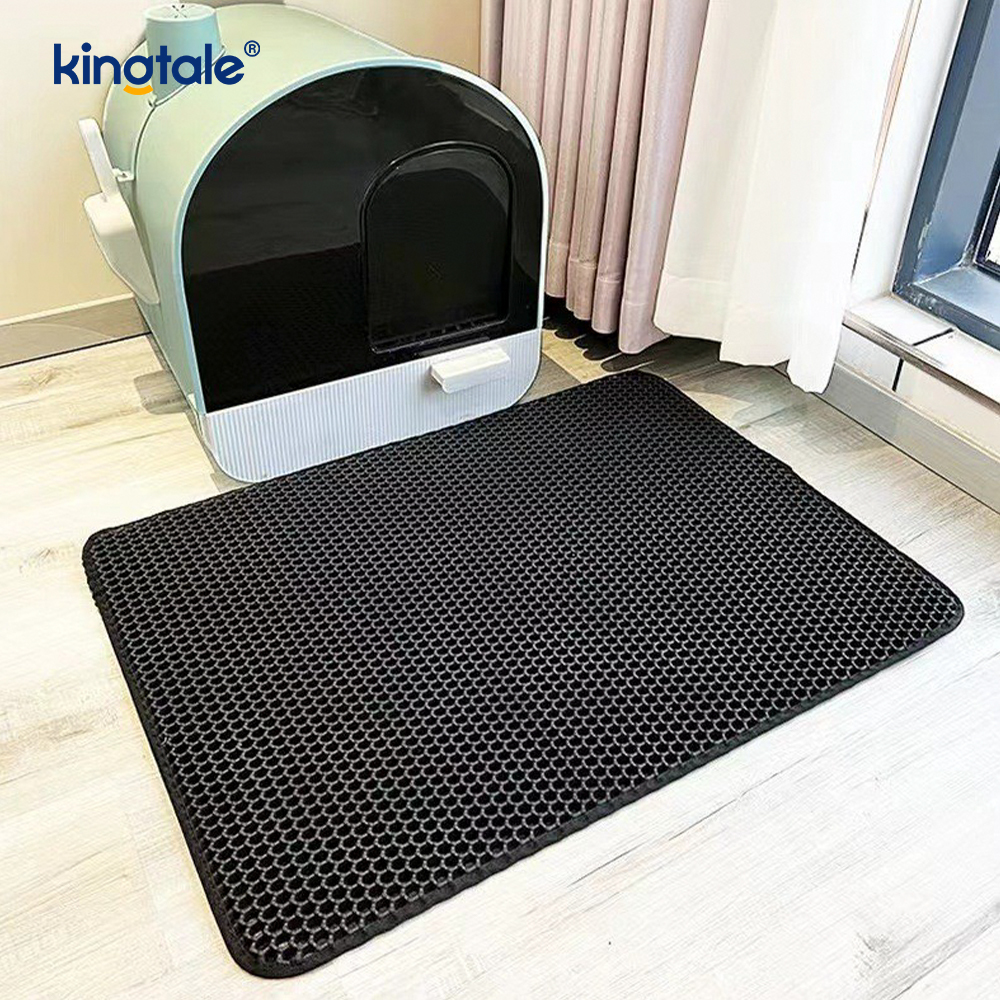 Large Double-Layer Honeycomb Cat Litter MatThe dual-layer honeycomb structure traps litter while its waterproof backing prevents moisture damage. It dries quickly, resists stains, and features a non-slip base for safety.View Product →
Cleaning and Lifespan: Why "Washable" Is Not Always Better
A mat that takes more than 12 hours to dry is a hygiene liability even if it is machine-washable. Moisture trapped inside absorbent foam creates the exact bacterial conditions you bought the mat to prevent.
- Wash frequency. Once per week for a single-cat home; two to three times per week for multi-cat homes.
- Drying time is the hidden spec. TPR and silicone dry in 2-4 hours. EVA and fabric mats can stay damp for 24-48 hours and should be avoided if you cannot rotate two mats.
- Replacement signal. Replace when the surface texture flattens, the backing loses grip, or ammonia odor survives a wash. Typical lifespans are 6-12 months for EVA and 12-18 months for TPR.
- Rotation strategy. Keep two mats in cycle so one is always dry and ready.
Wash the mat outside the litter zone and air-dry it in direct sunlight. UV exposure kills residual bacteria that detergents leave behind.
Upgraded Waterproof Cat Litter Mat with Double-Layer TrappingFeaturing a sealed, leak-proof bottom and a mesh top, this mat captures litter effectively and protects floors from liquid. Available in multiple sizes for optimal placement.View Product →Three Mistakes That Make Any Cat Litter Mat Fail
Most cat litter mat failures come from setup errors, not manufacturing defects. Each of these three mistakes is easy to fix before you order.
Mistake 1
Choosing a mat that is half the width of the litter box. Granules flick off the side edge and land on unprotected floor.
Fix 1
Choose a mat at least as wide as the box opening, or combine two mats for a wider coverage path.
Mistake 2
Buying a texture the cat dislikes. The cat starts jumping over or walking around the mat, and tracking returns to zero.
Fix 2
Test a sample material before committing to a bulk order. Soft EVA is usually the safest first choice.
Mistake 3
Ignoring the backing layer. On smooth tile or hardwood, a mat without grip slides under the cat's landing impact.
Fix 3
Select a mat with a rubber or TPR backing, or place a separate non-slip underlay beneath it.
In thousands of customer specifications across 16 years of pet product manufacturing, the three most common mat complaints trace back to size, texture preference, and slip resistance - not material price.
Frequently Asked Questions About Cat Litter Mats
Do cat litter mats really stop litter tracking?
Yes, when sized and positioned correctly. Controlled measurements of honeycomb TPR and EVA mats consistently show 70-80% granule removal from paw pads. A mat that is too small, too smooth, or outside the cat's exit path will return far lower results.
What is the best material for a cat litter mat?
TPR delivers the best combination of granule retention, fast drying, and durability, with a typical lifespan of 12-18 months. EVA is softer and more readily accepted by cats, but it absorbs moisture and lasts only 6-12 months. Silicone is easiest to clean but needs a deep textured pattern to retain granules effectively.
How often should I replace a cat litter mat?
Replace the mat when the surface texture flattens, the non-slip backing stops gripping, or ammonia odor remains after a wash. That interval is usually 6-12 months for EVA and 12-18 months for TPR, with more frequent replacements for high-use multi-cat households.
Can I put a cat litter mat under the litter box?
Yes, and it protects the floor from spills and splashes, but it will not control tracking. For tracking control, the mat must extend beyond the exit side and cover the cat's landing zone after it leaves the box.
Choosing a cat litter mat is a measurable decision: it reduces floor damage, lowers cleaning time, and trims annual litter waste. Evaluate texture, edge, backing, size, and drying speed before you order. If you need bulk supply or custom designs, contact our team for specifications matched to your market's requirements.



Reliable Materials - Sourced for performance and pet safety.

Quick Links
Ready to Customize Your Pet Products?
