

 English
 Español

Don't hesitate to send a message
Dog Chain Collar Guide: Materials, Sizing, and Training Uses for Buyers
Content
- 1 What a Dog Chain Collar Is and Why It Stays Relevant
- 2 Dog Chain Collar Materials: Strength, Coating and Corrosion
- 3 How to Size a Dog Chain Collar Without Guesswork
- 4 Slip Chain, Martingale or Prong: Which Design Fits the Job
- 5 Durability and Failure Points Every Buyer Should Inspect
- 6 Wholesale Sourcing: What to Verify Before You Order Chain Collars
- 7 Frequently Asked Questions About Dog Chain Collars
A 40 kg Mastiff hits the end of the lead at full drive, and the buckle of a flat nylon collar shears on the spot. In kennels and working-dog programs across Europe and North America, the dog chain collar is still the default answer to that failure, because welded metal links handle forces that webbing cannot. The category today spans slip chains, martingale half-chains, snake chains, prong collars and tie-out cables, and the difference between a reliable training tool and a return-prone product comes down to material, link geometry and fit.
What a Dog Chain Collar Is and Why It Stays Relevant
A dog chain collar is a metal training collar that tightens under leash tension and releases the instant the leash slackens, delivering a precisely timed correction instead of continuous pressure.
That release behavior is the entire point. A flat collar keeps applying pressure while the dog leans into the pull; a chain collar converts the same force into a short, sharp cue and then stops. Handlers who use it correctly install a reliable heel in far fewer sessions. The same mechanism makes it unsafe for unsupervised wear, so every safety rule in this guide follows from that distinction.
Practical uses that justify a metal chain
- Heel training for working, sporting and protection breeds
- Correction of pulling after flat collars and harnesses have failed
- Sighthound handling with martingale half-chains that prevent neck escape
- Grooming and kennel work where quick restraint and instant release matter
Dog Chain Collar Materials: Strength, Coating and Corrosion
Material choice decides what the collar looks like after a year of daily use: chrome-plated steel is strong but chips at the welds, stainless steel removes the corrosion failure point, and copper trades strength for lighter weight.
Most chain collar failures start with the coating, not the links. Chrome plating dominates the budget end because it is cheap and bright, but once it nicks at a weld, moisture reaches the carbon steel underneath and rust sets in. Stainless steel 304 avoids that process, which is why it is the default for outdoor work and heavy breeds. For small and medium dogs, copper chains offer a softer corrective feel and develop a patina, but their breaking strength runs 40 to 50 percent lower than stainless at the same gauge. A responsible supplier quotes the alloy and gauge in millimeters, not the phrase "heavy duty".
Estimated breaking strength at a 2.5 mm working diameter. Stainless steel leads the group while weighing about the same as chrome-plated chain.
| Material | Link gauge | Breaking load | Corrosion risk | Best application |
| Chrome-plated carbon steel | 2.0-3.2 mm | 250-320 kg | Moderate, coating chips | Indoor training, budget lines |
| Stainless steel 304 | 2.0-4.3 mm | 290-380 kg | Very low | Working dogs, outdoor use |
| Pure copper | 2.5-3.5 mm | 170-230 kg | Low, patina forms | Small and medium breeds |
| Nylon chain section (martingale) | 4-6 mm webbing | 180-260 kg | Very low | Daily walking, sighthounds |
How to Size a Dog Chain Collar Without Guesswork
Fit causes most chain collar returns: a collar that hangs low corrects the throat instead of the neck, and one that is too short never releases fully.
Measure the widest part of the dog's neck with a soft tape, then add 5 to 8 cm for a full slip chain. The collar should slide over the head when relaxed and pull snug only when the leash tightens. For a martingale half-chain, the chain section must never close completely. Ignore generic S, M, L labels: a 45 cm chain from one factory can behave like a 50 cm from another.
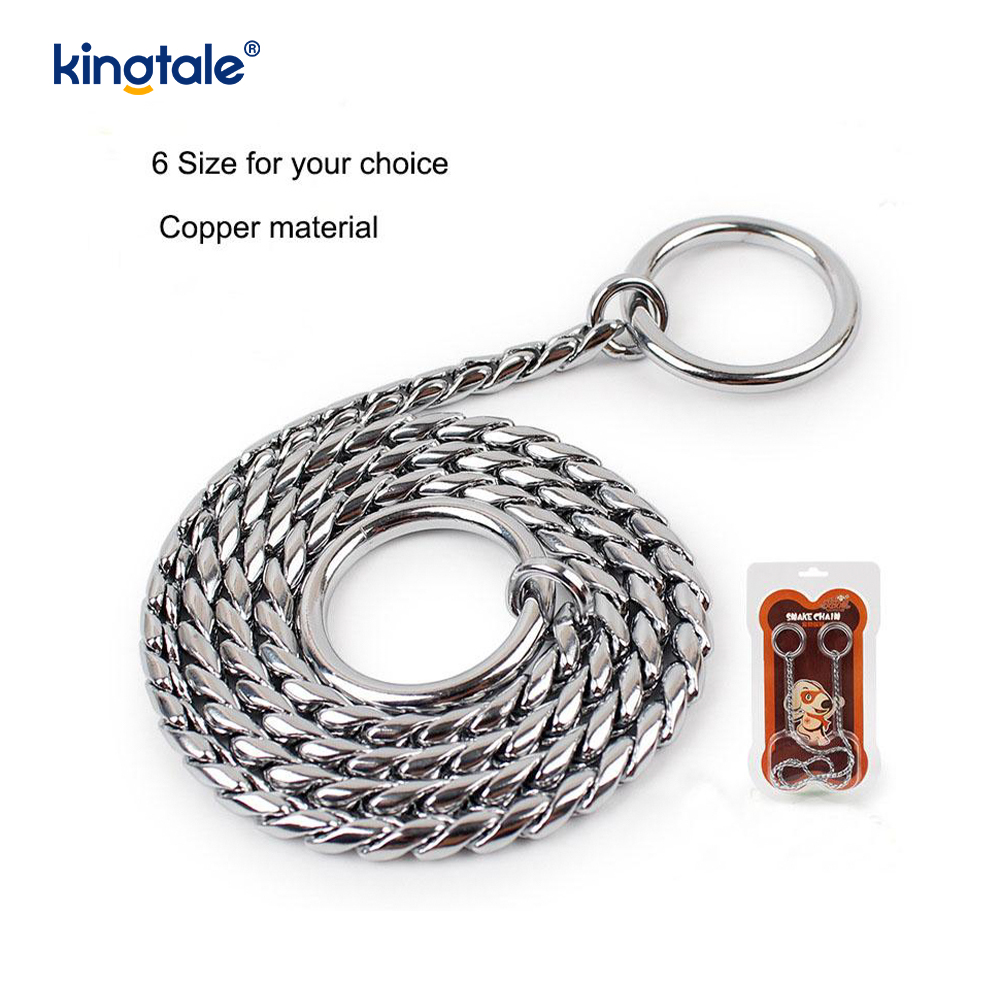 Pure Copper Metal Snake Dog Chain Collar for Small and Medium DogsMade of copper with an electroplated finish, this snake chain collar offers smooth contact to reduce fur snagging. Positioned after sizing guidance, it suits daily walks and basic training for small to medium breeds.View Product →
| Dog weight | Link gauge | Slip chain length | Martingale chain section |
| Under 10 kg | 2.0 mm | 30-40 cm | 15-22 cm |
| 10-25 kg | 2.5 mm | 40-55 cm | 22-30 cm |
| 25-40 kg | 3.2 mm | 50-65 cm | 30-38 cm |
| Over 40 kg | 4.3 mm | 60-75 cm | 38-48 cm |
Measure
Wrap the tape around the neck at its widest point after the dog has swallowed.
Add slack
Add 2 to 3 inches so the chain closes fully but never rests on the throat.
Test release
Pull and release the leash: the chain should return to slack within one second.
Slip Chain, Martingale or Prong: Which Design Fits the Job
Each metal collar design solves a different problem: the full slip chain is a strict correction tool, the martingale is a limited-slip safety collar, and the prong collar spreads pressure around the neck.
The full slip chain closes without limit, which gives precise timing but makes it unforgiving for new handlers. The martingale's fixed-length chain section limits closing to 2 to 3 inches, so it controls escape artists without strangling them. The prong collar distributes force over multiple blunted points instead of pressing the trachea.
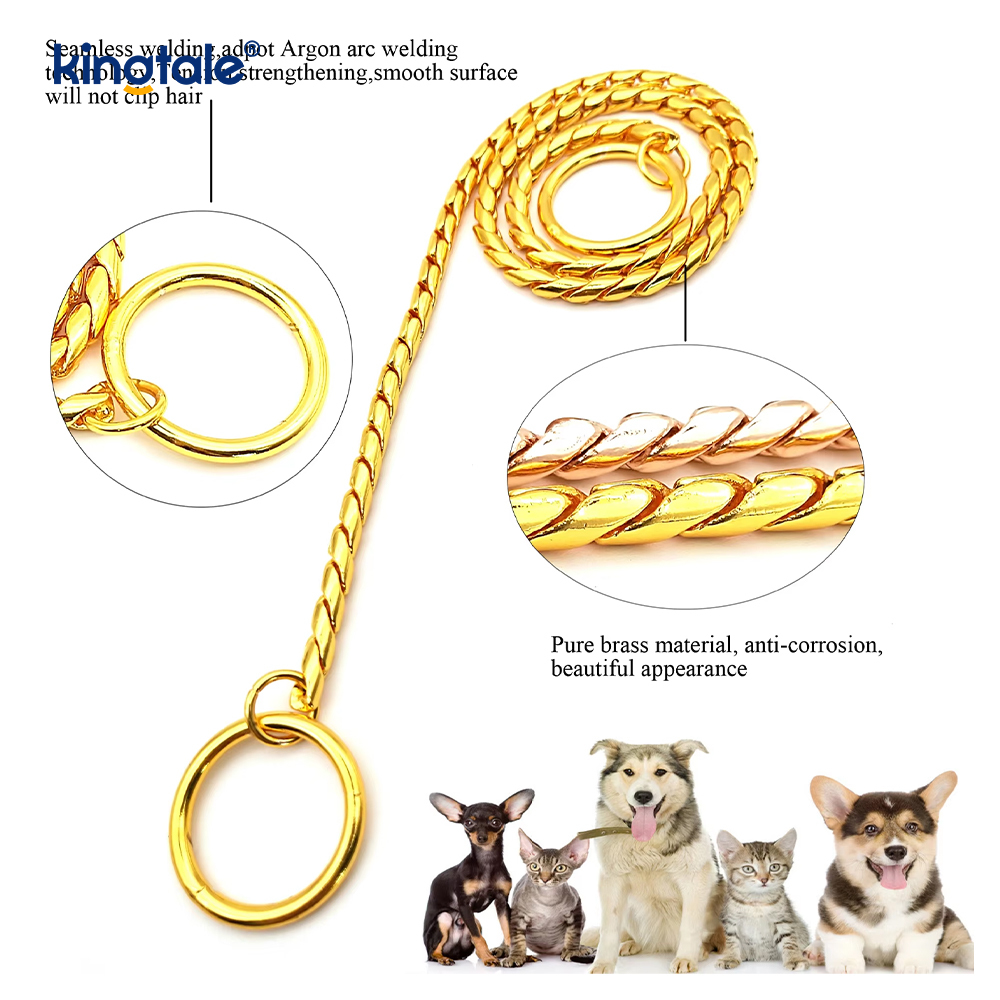 Electroplating Gold Snake Chain Training CollarThis gold snake chain forms a P-shape around the head, providing instant, clear cues during training when used correctly. Discussed alongside correction tools, it helps manage excitable dogs without continuous tightening.View Product →
Full slip chain
- Unlimited closure for precise correction
- Fastest release of any collar type
- Must be removed between sessions
- Highest strangulation risk if left on
Martingale half-chain
- Closes only 2 to 3 inches by design
- Keeps a flat-collar fit when slack
- Safe for supervised daily wear
- Chronic pulling still needs a harness
The catch is that correction tools are habit-forming for the human, not only the dog. Reaching for metal out of routine is how misuse happens; each training session should have a specific behavioral goal.
Durability and Failure Points Every Buyer Should Inspect
Metal collars fail in four predictable places: the weld, the swivel snap, the buckle and the coating.
A link that looks smooth can still fatigue if the weld is only on one side, so flexing multiple samples matters more than a single pull test. The swivel snap is the fastest-moving component; on cheap imports the stamped steel hook deforms at around 120 kg. Buckles should be tempered steel, not zinc alloy, which snaps under sudden load. For outdoor lines, PVC-coated cables resist moisture better than chrome, but uncoated stainless remains the lowest-maintenance option.
SS304alloy code that confirms corrosion-resistant chain
4.3 mmmaximum practical link gauge for giant breeds
3-pointswivel, weld and buckle QC checklist
50 msapproximate release time when leash tension drops
Weight consistency is the fastest field audit: weigh twenty collars from one shipment. Variance above 5 percent means link density or coating thickness is drifting between batches, and that drift shows up as inconsistent fit across your retail sizes.
Wholesale Sourcing: What to Verify Before You Order Chain Collars
For importers and brand owners, chain collar quality is a specification issue: request the alloy certificate, confirm the link gauge in millimeters, and break test samples before committing to volume.
- Confirm the alloy on paper: stainless steel 304 and 201 look alike, but 201 rusts after a few seasons.
- Verify link gauge with a micrometer on collars pulled from different cartons.
- Break test swivel snaps and buckles on a tensile tester.
- Measure weight per collar; variance above 5 percent indicates inconsistent production.
Zhangjiagang Kingtale International Co., Ltd. (Kingtale) operates a vertically integrated factory in Zhangjiagang and produces stainless, chrome-plated, copper and PVC-coated chain collars with OEM and ODM options, from link gauge selection to logo hardware. If you are building a dog chain collar line for your catalog, contact the Kingtale team with target sizes, quantities and delivery timeline.
Frequently Asked Questions About Dog Chain Collars
Is a dog chain collar safe for everyday walking?
No. A full slip chain is a training tool, not a walking collar. For daily walks, use a martingale half-chain or a harness; the dog should not wear a choke chain beyond the training session.
How tight should a chain collar sit on the dog?
Slack when the leash is loose and snug high on the neck only when tension is applied. If the collar hangs more than 3 to 5 cm below the standing position, it is too long.
Can a puppy wear a chain collar?
Wait until the dog's neck reaches adult size. Young dogs lack the neck muscle to handle correction timing safely, and tracheal injury during growth is a real risk.
What is the difference between a choke chain and a martingale chain?
A full choke chain can close completely, while a martingale's chain section is a fixed length and cannot close beyond it. The martingale is the safer choice for sighthounds, nervous dogs and handlers new to chain collars.



Reliable Materials - Sourced for performance and pet safety.
Quick Links
Ready to Customize Your Pet Products?
