

 English
 Español
Don't hesitate to send a message
How to Choose the Best Anti-Slip Dog Mats for Senior Dogs on Slippery Floors
Content
Fourteen-year-old Max, a Labrador Retriever with early hip dysplasia, lost his footing on polished ceramic tile and lay splayed on the floor for nearly a minute before his owner could reach him. Veterinary orthopedists see this pattern every week: a senior dog steps onto a slick floor, one hind leg slides sideways, and a cranial cruciate ligament tears or a hip strain becomes chronic. An anti-slip dog mat interrupts that sequence before an injury happens.
This guide covers the grip mechanics, materials, sizing rules, and sourcing considerations that separate a mat that actually works from one that simply slides along with the dog. The same principles apply whether you are buying one mat for an aging family pet or building a private-label product line for a pet retail brand.
What Makes an Anti-Slip Mat Actually Grip the Floor
A mat qualifies as anti-slip only when both of its surfaces generate friction: the underside must lock onto the flooring, and the top face must stop the dog's paws from splaying.
The underside is the part most buyers ignore. A flat rubber sheet slides on tile almost as easily as a towel. Effective anti-slip dog mats use suction-cup studs, a waffle grid, or dense TPR nubs that deform under the mat's own weight and hold out air, creating a vacuum against smooth surfaces. On textured or uneven floors, a heavier mat with a full-rubber backing outperforms a lightweight mat with aggressive studs, because studs need a smooth surface to seal.
The top surface matters just as much. Pebble, diamond, and hexagonal textures give paw pads something to push against when a dog shifts its weight to stand up. Smooth-topped mats are comfortable but do little to prevent the moment of failure when a dog rises from a lying position and its front feet shoot forward.
The chart above shows dry-tile coefficient-of-friction values for the materials most commonly used in anti-slip mats. Natural rubber and TPR lead by a wide margin, which is why most veterinary-recommended mats use one of those two. Anything below roughly 0.5 starts to behave like a slippery floor for an older dog.
Anti-slip dog mat: a floor covering with a high-friction underside and a textured top surface, engineered to prevent a dog's paws from sliding on smooth flooring such as tile, hardwood, laminate, and vinyl.
Anti-Slip Dog Mat Materials Compared
Choose the material by where the mat will live: TPR suits high-traffic doorways, natural rubber delivers maximum grip for senior dogs, PVC is the easiest to wipe clean, and EVA foam works as a lightweight temporary layer.
The table below compares the five materials most commonly used in anti-slip dog mats. Grip ratings reflect dry-tile coefficient of friction, and durability reflects resistance to tearing, cracking, and compression loss over roughly 12 months of daily use.
| Material | Dry grip | Durability | Cleaning method | Best placement |
| Natural rubber | Excellent | Excellent | Hand wash, air dry | Senior dog zones, corridors |
| TPR | Very good | Very good | Machine wash 30-40 C | Doorways, feeding areas |
| PVC | Good | Good | Wipe clean | Under water bowls, litter zones |
| EVA foam | Moderate | Moderate | Wipe clean | Travel, temporary coverage |
| Silicone | Good | High | Dishwasher safe | Puppy pens, chewers |
For most homes, TPR is the best overall value. It resists tearing, holds its grip after repeated wash cycles, and stays flexible in unheated rooms. Natural rubber outperforms it on raw friction but costs more per square meter and can leave a dark residue on light-colored floors. EVA foam is comfortable but wears quickly if a dog scratch-circles before lying down, so reserve it for travel.
Wet floors change the ranking. Water and urine reduce friction by roughly 40 percent on PVC and EVA, but by only about 15 percent on natural rubber and TPR. Near water bowls and in senior-dog zones, choose TPR or natural rubber.
Anti-Slip Dog Mat Thickness, Size, and Placement Rules
Buy a mat at least 4 mm thick for healthy adult dogs and 9 to 12 mm thick for seniors or dogs with joint conditions, then size it at least 1.5 times the area your dog occupies when lying flat.
Thin mats curl at the edges and create trip hazards. A 4 mm single-layer mat works beside a water bowl, but a dog that rises slowly needs a denser mat with beveled edges that will not catch a toenail. Measure the dog from the base of the neck to the base of the tail while it is stretched out, and add 50 percent in every direction.
- 4 to 6 mm thickness for everyday use at doorways, feeding stations, and under beds
- 9 to 12 mm thickness for orthopedic support, post-surgery recovery, and arthritic seniors
- Mat length at least 1.5 times the dog's body length from chest to hip
- Place mats at bed exits, water stations, patio doors, and every hallway the dog crosses at speed
- Butt mat edges together or leave a 2 cm gap; an overlapped edge curls and catches claws
4 mmminimum thickness for adult dogs
9 mmrecommended for seniors
1.5xlength multiplier for sizing
30-40 Csafe wash temperature
The 1.5x rule: a 25 kg dog measuring 70 cm from chest to hip needs a mat at least 105 cm long. A mat that size catches the full body at the moment of rising instead of only the front paws.
Hygiene and Safety: Washability, Toxicity, and Chew Resistance
An anti-slip dog mat must survive weekly washing and stay non-toxic under chewing, because it collects saliva, paw dirt, and the occasional accident in exactly the spaces where the dog sleeps and eats.
Machine-washable mats should be laundered at 30 to 40 degrees Celsius with a mild, fragrance-free detergent and air-dried. Wipe-only mats need a weekly sanitizing wipe-down, and they are less likely to breed mildew in humid climates. For material safety, verify phthalate-free PVC, food-grade silicone, or TPR that contains no heavy-metal stabilizers before you buy.
- Wash every 7 days in multi-dog households, every 14 days in single-dog homes
- Dry flat out of direct sunlight to keep the rubber from cracking
- Replace the mat when the backing stops gripping or the surface develops cracks
- Choose a waterproof core when covering puppy zones or litter areas
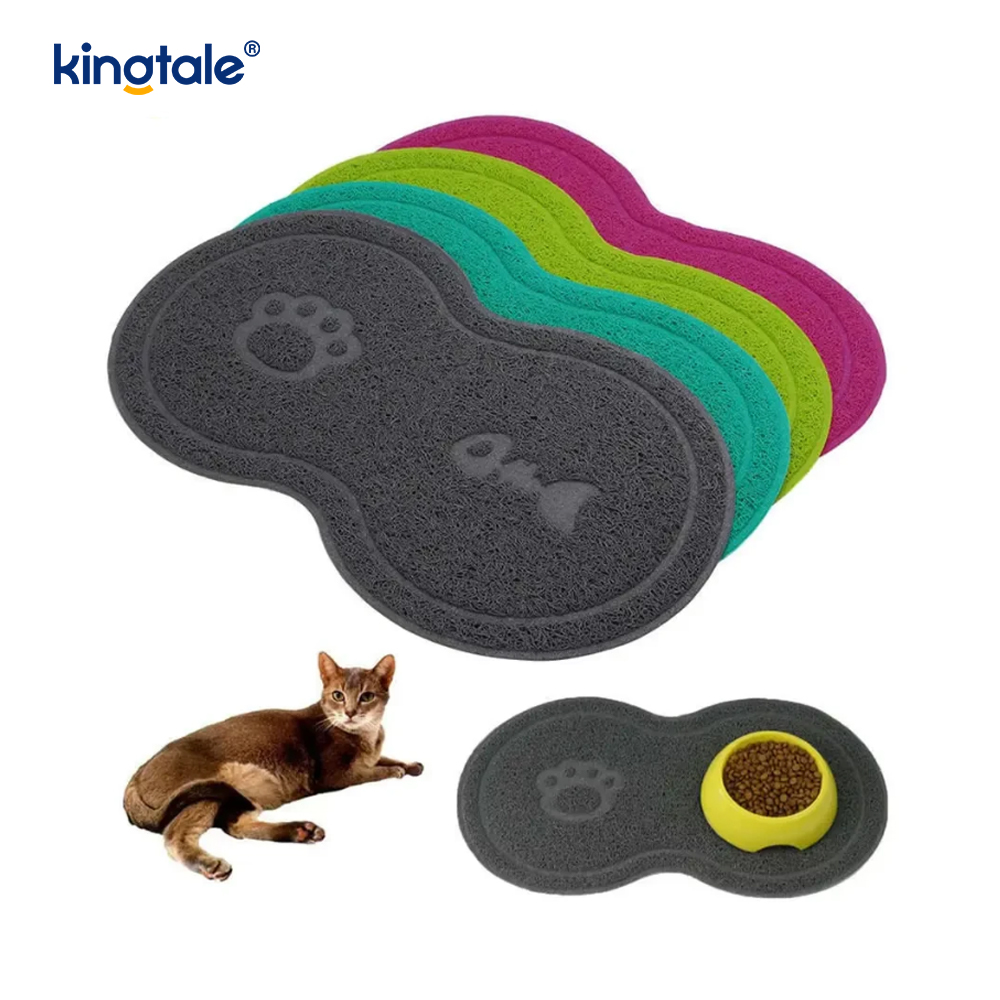 Waterproof Non-Slip PVC Cat Litter Box Mat with Bone Paw TextureThis mat's porous loop structure traps litter and food while its textured bottom prevents sliding. Made from non-toxic PVC, it is easy to rinse and suitable for placing under litter boxes or feeding bowls.View Product →
In a two-dog household, a single anti-slip mat accumulates more than 50 ml of saliva and paw moisture per week. At room temperature, that is enough to support bacterial growth within 48 hours if the mat is not cleaned on schedule.
Sourcing Anti-Slip Dog Mats for Retail and Private Label
Retail and e-commerce buyers should source anti-slip dog mats from a manufacturer that can adjust grip texture, thickness, dimensions, surface printing, and packaging, because those variables define the product's performance and its price point.
Ask every supplier for coefficient-of-friction data for both surfaces, a sample that has been through 20 wash cycles, and a chew-safety material declaration. A vertically integrated manufacturer such as Zhangjiagang Kingtale International Co., Ltd., which runs in-house production for its Kingtale Pets brand, can execute small pilot batches, apply custom logos and surface patterns, and scale to full container orders without changing the product specification.
Anti-slip mats are also part of a wider safety assortment, so use this guide to choosing pet essentials and comfort when building out a complete product range. Buyers who need quotes, lead times, or OEM/ODM options can message the Kingtale team through the contact page.
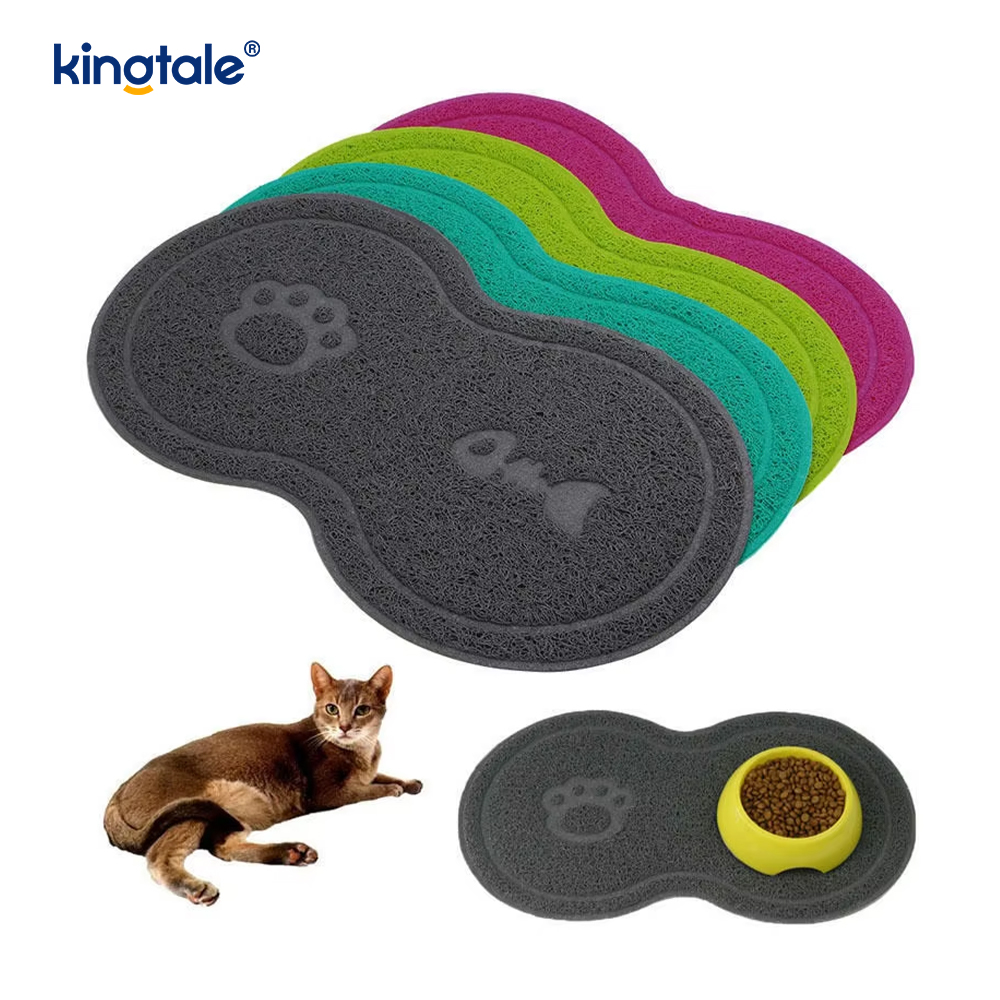 Gourd-Shaped Eco-Friendly PVC Pet Feeding and Litter MatDesigned for cats and small dogs, this waterproof mat features an 8-shaped design that fits litter boxes or feeding areas. Its non-slip base keeps it stable on hard floors, and cleaning is simple.View Product →
Supplier checklist for anti-slip mats:
- Coefficient-of-friction data for top and bottom surfaces
- A sample tested through 20 wash cycles
- Material safety declaration covering phthalates and heavy metals
- Pilot batch run before full production
Anti-Slip Dog Mat FAQ
Will an anti-slip dog mat work on carpet?
No. The underside grip that works on hard floors cannot bite into soft carpet, so the mat slides unless it uses carpet-specific anchors or added weight. Use a dense flat mat on hard floors and skip the anti-slip layer on carpet.
Can I use a yoga mat instead of an anti-slip dog mat?
A yoga mat is better than bare tile, but it is usually only about 3 mm thick while most dogs need 4 to 9 mm, and its smooth top surface offers little paw traction. Treat it as a temporary fix and replace it with a purpose-built mat.
Are anti-slip dog mats safe for puppies that chew?
Only if the material passes chew-safety standards. Food-grade silicone and phthalate-free TPR are the safest choices; avoid PVC for aggressive chewers. Replace any mat as soon as a puppy bites off a piece.
How often should I replace an anti-slip dog mat?
Every 12 to 24 months under normal use, or sooner when the backing no longer grips, the surface cracks, or the mat retains odors after washing. Dogs with long nails compress the backing faster and need earlier replacement.
A single well-placed anti-slip dog mat can be the difference between a dog that moves confidently through the house and one that hesitates at every doorway. Choose by coefficient of friction first, thickness second, and washability third.



Reliable Materials - Sourced for performance and pet safety.
Quick Links
Ready to Customize Your Pet Products?
