

 English
 Español
Don't hesitate to send a message
What Is a Cat Tree? Do Cats Really Need One | Complete Guide
Content
What Is a Cat Tree and Why Cats Actually Use Them
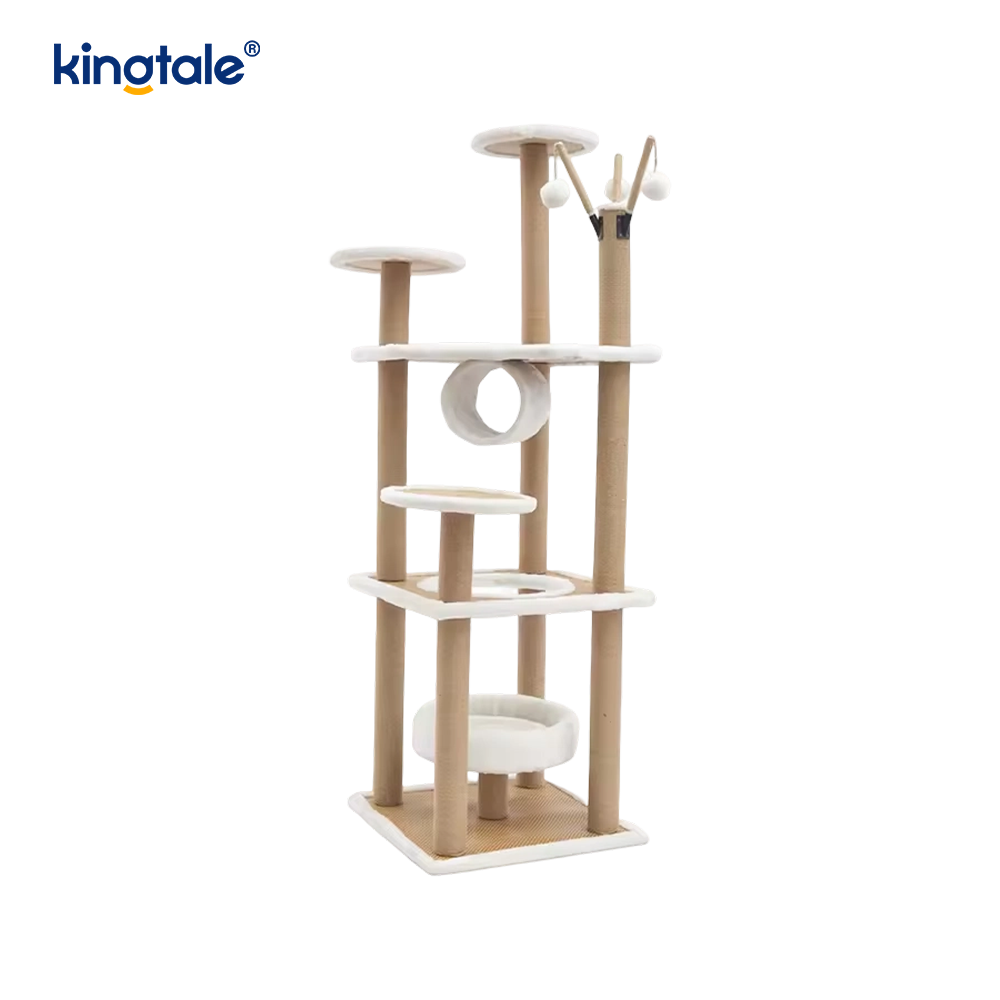
A cat tree — also called a cat tower or cat condo — is a freestanding structure built specifically for cats to climb, scratch, perch, and rest. Most combine vertical posts wrapped in sisal rope, horizontal platforms at varying heights, enclosed hideaway condos, dangling toys, and hammock-style loungers. Some models are compact and floor-standing; others run floor to ceiling, using tension rods to anchor against the room's surfaces without drilling.
Cats are instinctively drawn to height. In the wild, elevation provides safety from predators and a vantage point for watching prey. Even fully indoor cats carry that wiring. A cat tree channels those instincts into a designated structure, which reduces the chances of your cat using your bookshelves, refrigerator, or kitchen cabinets as a substitute.
Beyond instinct, cat trees also serve a practical behavioral function: they give cats a space they can call their own. In multi-cat households especially, vertical territory reduces conflict by allowing each cat to claim a level without confronting another.
Do Cats Need a Cat Tree?
Cats don't strictly require a commercial cat tree to be healthy — but they do need opportunities to climb, scratch, and perch at height. Without those outlets, most cats find their own solutions, which rarely align with what their owners prefer.
Studies on domestic cat behavior consistently show that indoor cats benefit from what's called environmental enrichment — physical structures and stimuli that allow them to express natural behaviors. Vertical space is one of the most important components. A 2018 review published in the Journal of Feline Medicine and Surgery identified lack of vertical territory as a significant stressor in indoor-only cats, correlating with increased anxiety-related behaviors like over-grooming and hiding.
The practical answer: if your cat already has access to stable, tall furniture it can climb safely, a dedicated cat tree is less urgent. If your living space is mostly floor-level and your cat shows signs of frustration — knocking things off surfaces, vocalizing, or pacing — a cat tree is one of the most effective environmental fixes available.
How much room do cats need overall? The general consensus among veterinary behaviorists is that vertical space matters more than floor area. A cat in a small apartment with good vertical options is typically more content than a cat in a large house with no elevated resting spots.
Do Cats Like Cat Trees?
Most cats do — but not automatically. Initial indifference is common and doesn't mean the cat dislikes the structure. Cats are cautious by nature and often need time to investigate something new before committing to it. Rubbing a small amount of catnip on platforms, placing familiar bedding on the top perch, or feeding treats near the base can shorten the warm-up period significantly.
Placement matters as much as the product. A cat tree tucked in a back hallway may sit unused while the same tree positioned near a window with outdoor sightlines gets constant traffic. Cats use elevated perches to observe — and what they can see from the perch determines how valuable the spot is to them.
Older cats or cats with joint issues may avoid cat trees with steep or widely spaced levels. Staggered platforms, ramps, or lower maximum heights make a significant difference in whether senior cats actually use the structure.
What to Look for in a Cat Tree: Materials and Build Quality
The materials used in a cat tree directly affect its durability, safety, and how enthusiastically cats use it. The main components to evaluate:
Core Structure
Most cat towers use particleboard or MDF for platforms and condos, sometimes with a plywood or solid wood frame. Solid wood and thick plywood cores are significantly more stable than particleboard alone, especially in taller structures. Particleboard is heavier than it sounds, but it also degrades faster with moisture exposure — relevant if the tree sits near a window or in a humid room.
Covering Materials
Platforms and condos are typically covered in faux fur, carpet, or plush fabric. Sisal rope wraps the scratching posts. Sisal is preferable to sisal fabric — the rope version holds up longer and satisfies the shredding instinct more effectively. Faux fur and carpet both attract hair and are harder to clean; some owners prefer minimal fabric coverage for that reason.
Base Stability
A wide, weighted base is the single most important safety feature on a freestanding cat tree. Tip-over risk is real, particularly with tall and skinny cat trees where the center of gravity is high. Before buying, check that the base footprint is proportional to the height. Some models include wall-anchor hardware as a secondary safety measure — worth using if the tree exceeds 5 feet.
| Material | Durability | Cat Appeal | Ease of Cleaning |
|---|---|---|---|
| Sisal rope posts | High | High | Easy |
| Carpet covering | Medium | High | Difficult |
| Faux fur | Medium | Very high | Difficult |
| Solid wood frame | Very high | Neutral | Easy |
| Particleboard core | Low–Medium | Neutral | Moderate |
Tall and Skinny Cat Trees vs. Floor-to-Ceiling Designs
Tall and skinny cat trees are popular in smaller spaces because they maximize vertical territory without consuming much floor area. The tradeoff is stability: the narrower the base relative to the height, the more easily the structure can tip under a jumping or wrestling cat. For single, lighter cats, this is manageable. For large breeds or multi-cat homes, it's a legitimate safety concern.
Floor-to-ceiling cat trees — sometimes called tension cat trees — solve the stability problem by pressing against both the floor and ceiling using an adjustable rod mechanism. They're inherently more secure than freestanding models at comparable heights, and they tend to look cleaner and more architectural in a room. The limitation is that they require ceilings within the product's adjustment range, usually 8 to 9.5 feet, and can leave marks on softer ceiling materials over time.
Cat trees with branches — designed to mimic real tree structures rather than stacked platforms — fall into their own category. They're typically built from wood with genuine branching architecture, offering a more organic climbing path. These designs appeal strongly to cats that prefer asymmetrical, irregular surfaces over uniform platform stacks.
Cat Trees That Look Like Real Trees
A growing segment of the cat tree market prioritizes aesthetics alongside function. Cat trees designed to look like actual trees — with bark-textured trunks, branch-style arms, and leaf-shaped platforms — are increasingly common. Some use real wood; others simulate it with sculpted foam or resin over a structural frame.
From a cat's perspective, the branch structure these designs use is genuinely more enriching than flat-platform alternatives. Branches at different angles require more active balancing and engage more muscle groups during climbing. A cat navigating an irregular branching structure gets a more physically stimulating experience than one jumping between identical horizontal shelves.
From an owner's perspective, the main benefit is that a well-designed tree-style cat tower functions as a piece of furniture rather than an eyesore. The design difference between a cat house (enclosed condo-style unit) and a tree-style tower is largely about open versus enclosed space — some cats strongly prefer the security of an enclosed hideaway, while others prefer open perches with wide sightlines.
One note on terminology: "safe trees for cats" in a literal, botanical sense refers to houseplants and outdoor trees that are non-toxic to cats — a different topic entirely. If you're concerned about plants, the ASPCA's toxic plant database is the most comprehensive resource. The cat trees discussed here are manufactured structures and don't carry that risk.
Where to Place a Cat Tree for Maximum Use
Placement is consistently underestimated. The same cat tree in two different positions in the same room can go from ignored to constantly occupied.
The highest-value placement criteria:
- Window access: A cat tree positioned so the top perch overlooks outdoor activity — birds, squirrels, foot traffic, or even just a garden — becomes a primary entertainment station. This is consistently the single most effective way to ensure daily use.
- Social proximity: Cats often prefer to rest near where their humans spend most time. A cat tree in a quiet guest room may get far less use than one in a living room or home office, even if the latter is smaller or has less natural light.
- Corner placement: Corners add structural stability to freestanding towers and give the cat a backed wall on two sides, which many cats prefer for perching.
- Away from heavy foot traffic paths: Cats want to observe activity, not be in the middle of it. Placing a tree immediately beside a main walking route can make cats feel exposed rather than elevated.
In multi-cat households, consider placing cat trees at multiple points in the home rather than clustering all vertical options in one area. This allows cats to establish separate territories within shared space, which reduces competition and stress.



Reliable Materials - Sourced for performance and pet safety.

Quick Links
Ready to Customize Your Pet Products?
