

 English
 Español
Don't hesitate to send a message
How to Stop a Dog from Biting the Leash: Training Tips That Work
Content
- 1 Why Dogs Bite and Chew on the Leash
- 2 How to Stop a Puppy from Biting the Leash: Step-by-Step
- 3 Dog Biting Leash While Walking: Specific Scenarios and Solutions
- 4 Choosing a Leash Your Dog Can't Easily Chew Through
- 5 How Long Does It Take to Stop Leash Biting?
- 6 Common Mistakes That Make Leash Biting Worse
Why Dogs Bite and Chew on the Leash
Leash biting is one of the most common complaints among new puppy owners, and it almost always has a straightforward explanation. Understanding why your dog is doing it is the first step toward fixing it effectively.
Overstimulation and frustration are the leading causes. When a puppy is excited about going outside but cannot move freely, the leash itself becomes the nearest available outlet for that pent-up energy. The moment the leash clips on, the behavior begins—biting, jumping, spinning, and tugging all at once.
Teething plays a significant role in puppies between 3 and 6 months old. During this period, chewing relieves the discomfort of incoming adult teeth, and a dangling leash is simply a convenient target. This is distinct from excitement-driven biting and often happens during calmer moments of a walk as well.
Attention-seeking is another driver that owners inadvertently reinforce. If biting the leash consistently results in the owner stopping, reacting, or engaging—even negatively—the dog learns that leash biting is an effective way to get attention. The behavior becomes self-reinforcing quickly.
Less commonly, leash biting can signal that the dog is stressed or uncomfortable on walks—for example, when encountering other dogs, loud traffic, or unfamiliar environments. In these cases the leash biting is a displacement behavior, not excitement.
How to Stop a Puppy from Biting the Leash: Step-by-Step
There is no single fix that works overnight, but a consistent multi-step approach resolves leash biting in most puppies within two to four weeks of dedicated practice.
Step 1: Manage Excitement Before the Walk Begins
Most leash biting starts before you even leave the house. If your puppy is already spinning and jumping when you reach for the leash, clipping it on at that moment rewards high arousal. Instead, wait. Hold the leash and do nothing until your puppy has all four paws on the floor and is relatively calm. Only then clip the leash. This alone dramatically reduces biting frequency for many puppies, because it breaks the conditioned association between leash = immediate excitement explosion.
Step 2: Redirect Immediately and Consistently
Keep a high-value chew or toy in your pocket specifically for walks. The moment your dog grabs the leash, calmly offer the toy as an alternative. Do not pull the leash away or make it a game—that increases the dog's interest in it. The goal is to give your puppy something more rewarding to hold in their mouth. Some trainers recommend a bully stick or long-lasting chew at the start of a walk as a proactive strategy, giving the puppy an outlet before the impulse to bite the leash arises.
Step 3: Use Negative Punishment, Not Positive Punishment
When the puppy bites the leash, immediately stop walking. Stand still, look away, and offer zero interaction. The moment they release the leash—even briefly—resume walking. Movement is the reward; stopping is the consequence. This approach, known as negative punishment (removing something the dog wants), is far more effective and humane than corrections, jerks, or verbal scolding, all of which tend to increase arousal and worsen the behavior.
Step 4: Increase Exercise Before Walks
A puppy that has already burned some energy through indoor play or a short fetch session before the walk begins is significantly less likely to redirect frustration onto the leash. Five to ten minutes of active indoor play immediately before clipping the leash on can make a measurable difference in walk behavior. This is especially useful for high-energy breeds like Border Collies, Jack Russell Terriers, and Australian Shepherds.
Step 5: Reward Loose-Leash Walking Frequently
Many owners focus entirely on correcting bad leash behavior while ignoring the good moments. When your puppy is walking beside you without biting or pulling, mark the moment with a quiet "yes" and offer a small treat. Doing this every 20–30 seconds during a training walk builds a strong positive association with calm leash behavior and accelerates progress considerably.
Dog Biting Leash While Walking: Specific Scenarios and Solutions
Dog Biting Leash and Jumping Simultaneously
This combination—biting and jumping at the same time—is a high-arousal pattern most common in puppies between 8 and 20 weeks. It signals that the dog is overwhelmed with excitement and has not yet developed impulse control. The most effective response is a complete freeze: stop moving, cross your arms, turn your body sideways, and wait. Do not look at the dog, speak to it, or push it down. Any physical or verbal engagement at this moment increases arousal. Most puppies will de-escalate within 30–60 seconds when this approach is applied consistently.
Dog Attacks Leash Around Other Dogs
If your dog specifically bites the leash when encountering other dogs on walks, the underlying cause is likely frustration or barrier reactivity rather than simple excitement. Dogs that want to greet other dogs but cannot reach them often redirect that frustration to the nearest available object—which is the leash. The fix here is different from excitement-based biting: increase distance from other dogs to a threshold where your dog can observe them without reacting, then reward calm behavior at that distance repeatedly. Over time, the threshold decreases.
Puppy Chewing on Leash During Calm Moments
If the biting happens during quiet moments—standing still, sniffing, or resting—rather than during high-energy bursts, teething is usually the cause. Providing a frozen rubber chew toy or a chilled teething ring before walks gives the puppy's mouth something to focus on. Bitter apple spray applied to the leash can also deter chewing; most puppies find the taste aversive, though a small percentage are indifferent to it.
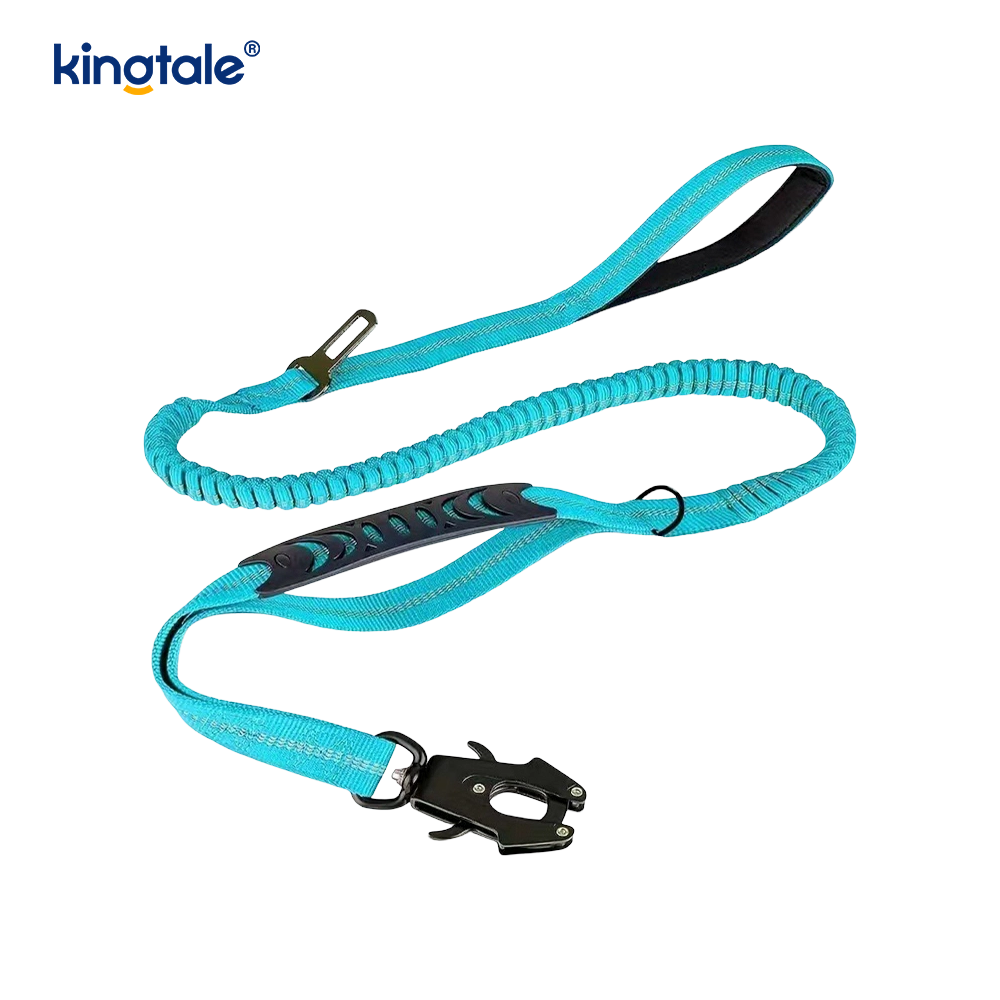
Choosing a Leash Your Dog Can't Easily Chew Through
While training is the long-term solution, the right equipment can reduce damage and improve safety during the process. Leash material makes a significant difference in how quickly a determined chewer can destroy it.
- Standard nylon leashes are the most common and the least chew-resistant. A motivated puppy can bite through a thin nylon leash in under a minute.
- Thick braided nylon or rope leashes offer more resistance due to their diameter, though they are not indestructible. Their texture can also be more satisfying to chew, which can backfire.
- Leather leashes are durable and often preferred by trainers for their strength and feel. A quality 6-foot leather leash is significantly harder to chew through than nylon, though it is not immune to a persistent teething puppy.
- Chain leashes with a fabric handle are the most chew-proof option available for consumer use. The metal links are impractical for a dog to bite through. However, they are heavier, louder, and can injure a dog's mouth if the dog bites down hard—so they are better suited as a temporary management tool than a long-term solution.
- Biothane leashes are a newer option that combines durability with a smooth surface that is less appealing to chew than textured materials. Waterproof and easy to clean, they are increasingly popular among owners of chewing-prone dogs.
No leash is truly indestructible under sustained chewing. Equipment should always be paired with active training rather than used as a substitute for it.
How Long Does It Take to Stop Leash Biting?
With consistent application of the techniques above, most puppies show noticeable improvement within 1–2 weeks and reliable improvement within 3–4 weeks. Several factors affect how quickly the behavior resolves:
| Factor | Faster Resolution | Slower Resolution |
|---|---|---|
| Training consistency | Same response every time | Inconsistent; sometimes allowed |
| Puppy age | Under 16 weeks | Older dog with established habit |
| Exercise level | Adequate daily exercise | Under-exercised, high-energy breed |
| Reinforcement history | Behavior never rewarded | Owner previously engaged with biting dog |
If leash biting persists beyond four weeks of consistent training, or if the behavior is accompanied by growling, stiff body posture, or hard biting that breaks skin, it is worth consulting a certified professional dog trainer or veterinary behaviorist. In a small subset of cases, leash biting is rooted in anxiety or reactivity that benefits from a more structured behavior modification program.
Common Mistakes That Make Leash Biting Worse
Many well-intentioned responses to leash biting actually prolong the problem. Avoid the following:
- Pulling the leash away repeatedly. This turns biting into a tug-of-war game, which most dogs find highly rewarding. The leash becomes more interesting, not less.
- Verbal corrections like "no" or "stop." For many puppies, any vocalization from the owner reads as engagement, which increases excitement and therefore biting.
- Spraying the dog with water. While this sometimes startles a dog into stopping momentarily, it does not teach an alternative behavior and often creates a negative association with walks altogether.
- Continuing the walk while the dog is biting. Forward movement while the dog has the leash in its mouth rewards the behavior with exactly what the dog wants most—progress on the walk.
- Skipping walks to avoid the problem. Reduced exercise increases the energy surplus that drives the behavior in the first place, creating a worsening cycle.



Reliable Materials - Sourced for performance and pet safety.

Quick Links
Ready to Customize Your Pet Products?
